> ## Documentation Index
> Fetch the complete documentation index at: https://docs.go.aiinsurance.io/llms.txt
> Use this file to discover all available pages before exploring further.
# Exposure
> A thing being insured — the central hub the rest of the workflow references.
An **exposure** is a thing being insured — a business, a building, a vehicle, a
person. It's the canonical record of an insured risk, and it sits at the **center**
of the model: submissions, quotes, policies, and events all reference exposures.
If a submission asks "can you cover *this*?", the *this* is an exposure.
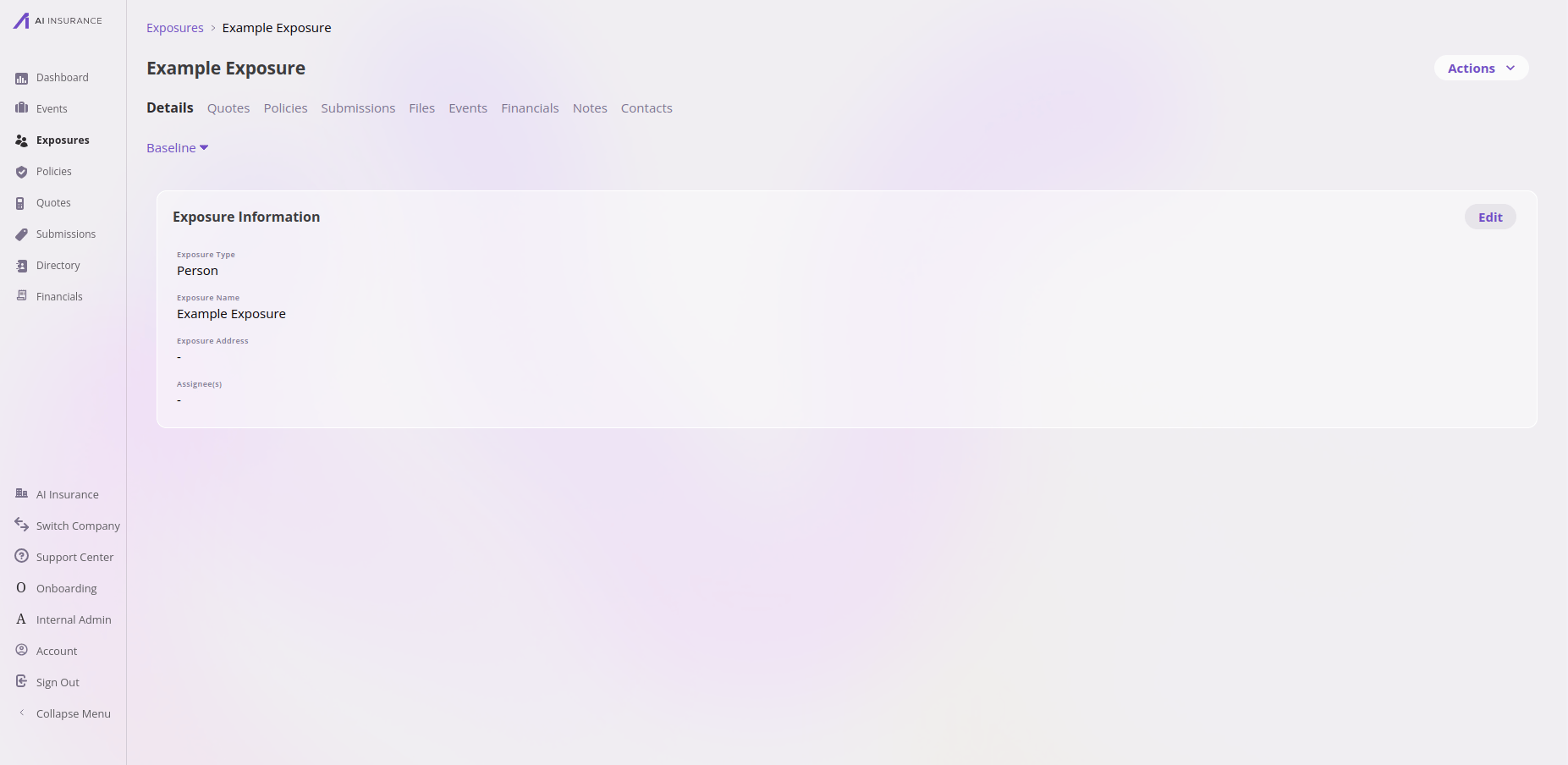 Working in the app? See the [Exposures feature reference](/app/features/exposures) for the list view, creating exposures, and the cross-reference detail hub.
## How its data works
An exposure is a set of **fields configured per company**. The platform requires a
name and a type; beyond that, the details you capture about a risk are entirely up
to your configuration. The exposure record is the single source of truth for that
risk's own data.
## What it connects to
Exposures are the **hub** — every other part of the workflow can reference them
(all many-to-many):
| Connects to | How |
| ----------------------------------- | --------------------------------------------- |
| [Submissions](/entities/submission) | The submissions that reference this exposure. |
| [Quotes](/entities/quote) | The quotes that reference this exposure. |
| [Policies](/entities/policy) | The policies that cover this exposure. |
| [Events](/entities/event) | The events (claims) that touch this exposure. |
Each of those entities holds *its* list of exposures; the exposure reads back the
reverse — "which quotes/policies/submissions/events reference me?" — automatically.
## How exposures attach to policies
This is the part of the model that's easy to get wrong, so it's worth spelling
out. An exposure relates to a policy differently from how it relates to a
submission or quote.
A submission or quote simply **points at** an exposure — a shared link. But a
policy needs to be able to **change the facts** about an exposure over the life of
the term (an endorsement updates an address, a building value, a vehicle) *without*
rewriting history or affecting anyone else's view of that exposure.
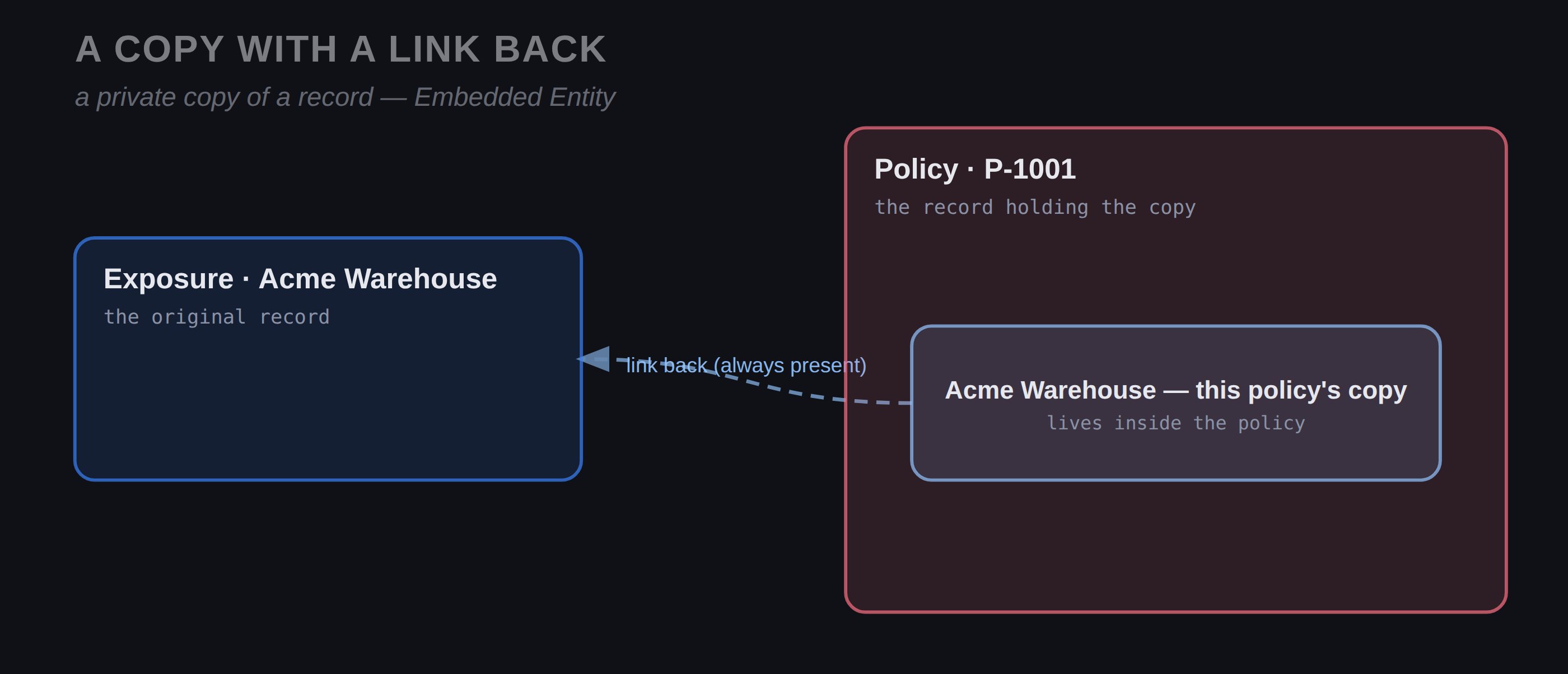
So a policy keeps its **own private copy** of the exposure's data, embedded in the
policy itself, with a permanent pointer back to the canonical exposure record:
* The **canonical exposure** keeps existing on its own, with its own page, no
matter how many policies cover it.
* Each **policy** that covers it gets its own copy of the exposure's data, which it
can edit independently. The copy starts identical to the original and may drift
from it over time.
* The copy and the original **never sync** — only the pointer between them is
shared.
In other words: for every policy linked to an exposure, that exposure effectively
has its own data record *for that policy*. The exposure itself remains the single
canonical record of the risk.
Working in the app? See the [Exposures feature reference](/app/features/exposures) for the list view, creating exposures, and the cross-reference detail hub.
## How its data works
An exposure is a set of **fields configured per company**. The platform requires a
name and a type; beyond that, the details you capture about a risk are entirely up
to your configuration. The exposure record is the single source of truth for that
risk's own data.
## What it connects to
Exposures are the **hub** — every other part of the workflow can reference them
(all many-to-many):
| Connects to | How |
| ----------------------------------- | --------------------------------------------- |
| [Submissions](/entities/submission) | The submissions that reference this exposure. |
| [Quotes](/entities/quote) | The quotes that reference this exposure. |
| [Policies](/entities/policy) | The policies that cover this exposure. |
| [Events](/entities/event) | The events (claims) that touch this exposure. |
Each of those entities holds *its* list of exposures; the exposure reads back the
reverse — "which quotes/policies/submissions/events reference me?" — automatically.
## How exposures attach to policies
This is the part of the model that's easy to get wrong, so it's worth spelling
out. An exposure relates to a policy differently from how it relates to a
submission or quote.
A submission or quote simply **points at** an exposure — a shared link. But a
policy needs to be able to **change the facts** about an exposure over the life of
the term (an endorsement updates an address, a building value, a vehicle) *without*
rewriting history or affecting anyone else's view of that exposure.
So a policy keeps its **own private copy** of the exposure's data, embedded in the
policy itself, with a permanent pointer back to the canonical exposure record:
* The **canonical exposure** keeps existing on its own, with its own page, no
matter how many policies cover it.
* Each **policy** that covers it gets its own copy of the exposure's data, which it
can edit independently. The copy starts identical to the original and may drift
from it over time.
* The copy and the original **never sync** — only the pointer between them is
shared.
In other words: for every policy linked to an exposure, that exposure effectively
has its own data record *for that policy*. The exposure itself remains the single
canonical record of the risk.
 ## Files, Notes & Contacts
Exposures support all three shared tabs: **upload files**, record **notes**, and
attach **contacts** (people from the directory).
**API.** Managed through the unified entity CRUD surface as `exposure`. See the
[Entities API overview](/api-reference/entities/overview).
**Framework-required fields.**
| Field | Notes |
| --------------------------- | ------------------------------------------------------------------------------ |
| `exposureName` | Display name. |
| `exposureType` | Option Set (required). |
| `policyRelationshipType` | Option Set. |
| `crossSegmentRatingOutputs` | Object. |
| `contacts` | People linked as contacts (join to Person). |
| `referencingQuotes` | Quotes referencing this exposure (reverse-read). |
| `referencingPolicies` | Policies covering this exposure — unions across the whole term (reverse-read). |
| `referencingSubmissions` | Submissions referencing this exposure (reverse-read). |
| `referencingEvents` | Events touching this exposure. |
The "own copy on a policy" described above is an **embedded exposure** field on the
Policy side — a copy of the exposure's data with a required pointer back to the
canonical exposure id. Additional fields are configured per company; discover them
via the `/entities/exposure/configuration` endpoint.
## Files, Notes & Contacts
Exposures support all three shared tabs: **upload files**, record **notes**, and
attach **contacts** (people from the directory).
**API.** Managed through the unified entity CRUD surface as `exposure`. See the
[Entities API overview](/api-reference/entities/overview).
**Framework-required fields.**
| Field | Notes |
| --------------------------- | ------------------------------------------------------------------------------ |
| `exposureName` | Display name. |
| `exposureType` | Option Set (required). |
| `policyRelationshipType` | Option Set. |
| `crossSegmentRatingOutputs` | Object. |
| `contacts` | People linked as contacts (join to Person). |
| `referencingQuotes` | Quotes referencing this exposure (reverse-read). |
| `referencingPolicies` | Policies covering this exposure — unions across the whole term (reverse-read). |
| `referencingSubmissions` | Submissions referencing this exposure (reverse-read). |
| `referencingEvents` | Events touching this exposure. |
The "own copy on a policy" described above is an **embedded exposure** field on the
Policy side — a copy of the exposure's data with a required pointer back to the
canonical exposure id. Additional fields are configured per company; discover them
via the `/entities/exposure/configuration` endpoint.