> ## Documentation Index
> Fetch the complete documentation index at: https://docs.go.aiinsurance.io/llms.txt
> Use this file to discover all available pages before exploring further.
# Entities Overview
> The top-level entities in AI Insurance — what they are, how their data works, and how they connect.
AI Insurance is built around a small set of **top-level entities** — the real-world
things the platform keeps track of. Each one is a *record*: it exists in its own
right, has its own detail page, shows up in lists, and can be linked to other
records.
There are seven top-level entities:
| Entity | What it represents |
| -------------------------------------- | ------------------------------------------------------------------ |
| [Submission](/entities/submission) | An incoming request to be quoted — the start of the workflow. |
| [Quote](/entities/quote) | A priced offer worked up from a submission. |
| [Policy](/entities/policy) | A bound, in-force contract of insurance. |
| [Event](/entities/event) | A claim or incident reported against a policy. |
| [Exposure](/entities/exposure) | A thing being insured (a business, building, vehicle, person). |
| [Person](/entities/person) | An individual in the directory — a broker, attorney, contact, etc. |
| [Organization](/entities/organization) | A company or firm in the directory. |
## What every entity has in common
**They all carry fields.** Every entity's data is just a set of fields, and the
exact set is **configured per company**. Some fields are required by the platform
(for example, an exposure always has a name and a type), but beyond those you can
add as many custom fields as you like — text, numbers, dates, yes/no, dropdowns,
and nested objects. Two companies using AI Insurance can model the same entity
very differently.
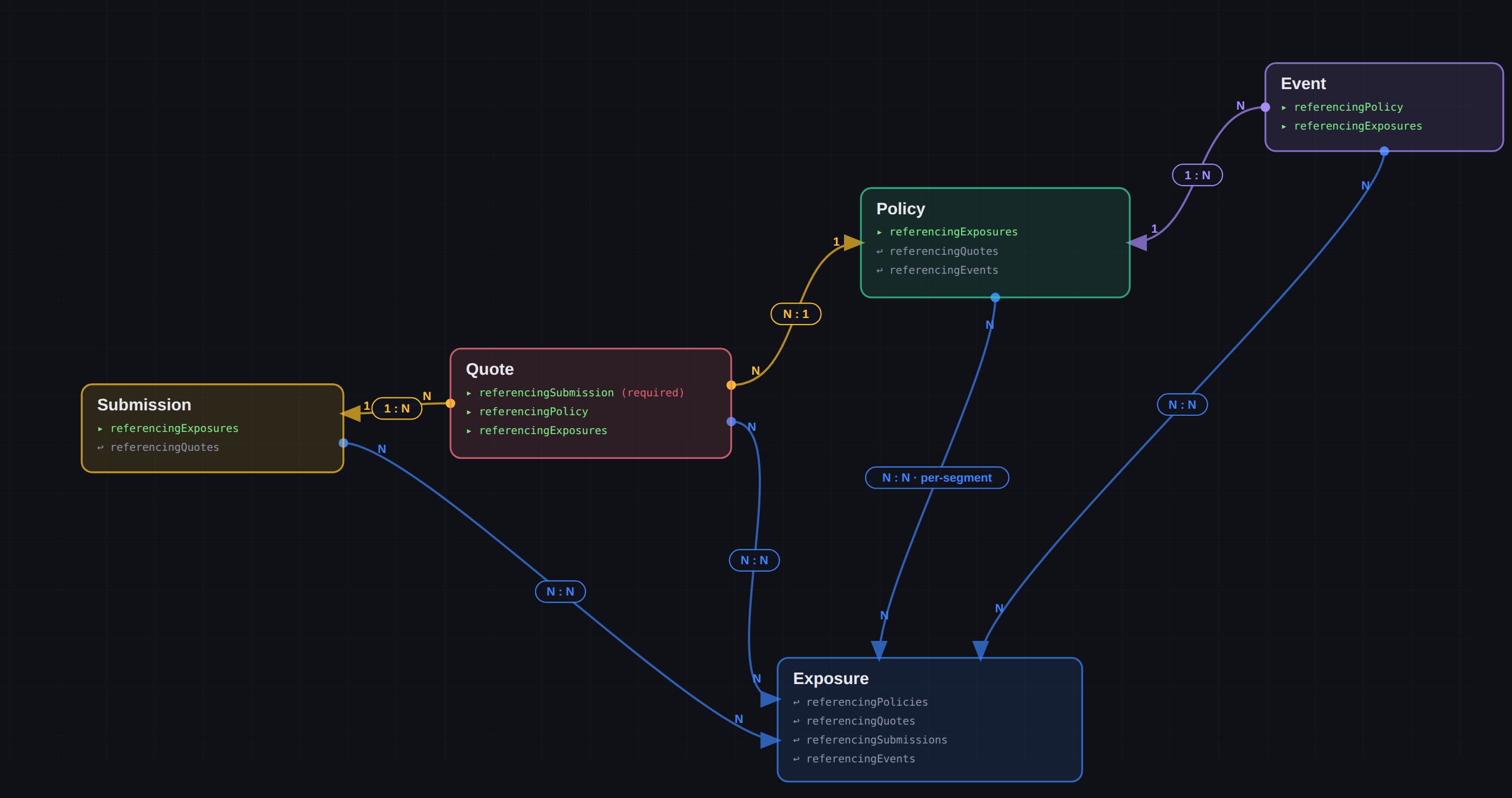
**They all connect to each other.** A submission fans out into quotes, a quote
binds into a policy, a policy accrues events, and exposures sit at the center —
referenced by submissions, quotes, policies, and events alike. See
[How entities relate](#how-entities-relate) below.
**They support Files, Notes, and Contacts — though not uniformly.** **Notes** are
available on nearly every entity; **Files** and **Contacts** appear on a smaller
set (Exposure, Event, and Submission). Where they appear, each works the same way:
* **Files** — upload arbitrary documents and attachments.
* **Notes** — free-text notes recorded against the record.
* **Contacts** — link people (from the directory) to the record.
See the table below for exactly which entity has which.
These three are **not** present on every entity. Today they appear as follows:
| Entity | Files | Notes | Contacts |
| ------------ | :---: | :---: | :------: |
| Exposure | ✓ | ✓ | ✓ |
| Event | ✓ | ✓ | ✓ |
| Submission | ✓ | ✓ | ✓ |
| Quote | — | ✓ | — |
| Person | — | ✓ | — |
| Organization | — | ✓ | — |
| Policy | — | — | — |
This table reflects the **in-app tabs**: Exposure, Event, and Submission show all
three; Quote, Person, and Organization show Notes only; Policy shows none.
The **API is broader** than the in-app tabs. Through the API, **notes** can be
recorded against every top-level entity type (Policy included), and **files** can
be attached to every entity type as well as at the company level — even where the
app doesn't surface a tab for it.
## How entities relate
For most entities, a link is stored on **one** side (the side you edit) and read
back automatically from the other side. The full set of relationships:
| Relationship | How many | Notes |
| ---------------------------------------------- | -------------------------------------------- | ----------------------------------------------------------------------------- |
| Quote → Submission | Many quotes belong to one submission | **Required** — every quote belongs to a submission. |
| Quote → Policy | Many quotes can bind into one policy | Set when a quote is bound. |
| Event → Policy | A policy has many events | Each event names the policy it was reported against. |
| Submission / Quote / Policy / Event → Exposure | Many-to-many | Exposures are the shared hub — every part of the workflow can reference them. |
| Person → Organization | A person belongs to at most one organization | Optional. |
| Event / Exposure / Submission → Person | Many-to-many ("Contacts") | People linked to a record as contacts. |
 ## The building blocks
Under the hood, everything in the platform is built from four ideas. You don't
need these to use AI Insurance, but they explain *why* the entities behave the way
they do:
* **Record** — a thing that exists on its own, with its own id, page, and place in
a list. Every top-level entity is a record.
* **Field** — a single value on a record. The set of fields is configured per
company.
* **Link (Join)** — two records pointing at one shared record (a person linked to
an organization, a contact linked to an event). A link is readable from both
sides.
* **Embedded copy** — a record that another record keeps its *own private copy*
of, with a permanent pointer back to the original. This is how a
[policy carries exposure data](/entities/exposure#how-exposures-attach-to-policies)
it can change over time without rewriting history for everyone else.
**Entity types (API slugs).** Six entities are managed through the unified CRUD
surface, keyed on a lowercase-kebab `{entityType}` slug: `event`, `exposure`,
`quote`, `submission`, `person`, `organization`. **Policy is not a CRUD entity** —
its writes go through the [Policy Transaction
API](/api-reference/policies/overview). See the [Entities API
overview](/api-reference/entities/overview) for the request/response envelope,
`PATCH` merge semantics, configuration discovery, and permissions.
**Relationship fields.** Cross-entity links use `referencing*` fields. The link is
written on one entity and read back from the other (for most pairs the reverse is
read-only; Event ↔ Exposure can be written from either side):
| Relationship | Written on | Reverse field |
| -------------------------------------------------- | --------------------------------- | --------------------------------- |
| Quote ↔ Submission (N:1, required) | `Quote.referencingSubmission` | `Submission.referencingQuotes` |
| Quote ↔ Policy (N:1) | `Quote.referencingPolicy` | `Policy.referencingQuotes` |
| Event ↔ Policy (N:1) | `Event.referencingPolicy` | `Policy.referencingEvents` |
| Policy ↔ Exposure (N:N, per-segment) | `Policy.referencingExposures` | `Exposure.referencingPolicies` |
| Quote ↔ Exposure (N:N) | `Quote.referencingExposures` | `Exposure.referencingQuotes` |
| Submission ↔ Exposure (N:N) | `Submission.referencingExposures` | `Exposure.referencingSubmissions` |
| Event ↔ Exposure (N:N) | `Event.referencingExposures` | `Exposure.referencingEvents` |
| Person ↔ Organization (N:1) | `Person.organization` | `Organization.people` |
| Contacts: Event/Exposure/Submission ↔ Person (N:N) | `contacts` on the record | — |
Note `referencingSubmission` is **singular** (a quote has exactly one submission);
the rest are lists. Relationship ids are stored in a separate join table, not in
the entity's own field data — they are stripped from the request body on write and
injected back on read.
## The building blocks
Under the hood, everything in the platform is built from four ideas. You don't
need these to use AI Insurance, but they explain *why* the entities behave the way
they do:
* **Record** — a thing that exists on its own, with its own id, page, and place in
a list. Every top-level entity is a record.
* **Field** — a single value on a record. The set of fields is configured per
company.
* **Link (Join)** — two records pointing at one shared record (a person linked to
an organization, a contact linked to an event). A link is readable from both
sides.
* **Embedded copy** — a record that another record keeps its *own private copy*
of, with a permanent pointer back to the original. This is how a
[policy carries exposure data](/entities/exposure#how-exposures-attach-to-policies)
it can change over time without rewriting history for everyone else.
**Entity types (API slugs).** Six entities are managed through the unified CRUD
surface, keyed on a lowercase-kebab `{entityType}` slug: `event`, `exposure`,
`quote`, `submission`, `person`, `organization`. **Policy is not a CRUD entity** —
its writes go through the [Policy Transaction
API](/api-reference/policies/overview). See the [Entities API
overview](/api-reference/entities/overview) for the request/response envelope,
`PATCH` merge semantics, configuration discovery, and permissions.
**Relationship fields.** Cross-entity links use `referencing*` fields. The link is
written on one entity and read back from the other (for most pairs the reverse is
read-only; Event ↔ Exposure can be written from either side):
| Relationship | Written on | Reverse field |
| -------------------------------------------------- | --------------------------------- | --------------------------------- |
| Quote ↔ Submission (N:1, required) | `Quote.referencingSubmission` | `Submission.referencingQuotes` |
| Quote ↔ Policy (N:1) | `Quote.referencingPolicy` | `Policy.referencingQuotes` |
| Event ↔ Policy (N:1) | `Event.referencingPolicy` | `Policy.referencingEvents` |
| Policy ↔ Exposure (N:N, per-segment) | `Policy.referencingExposures` | `Exposure.referencingPolicies` |
| Quote ↔ Exposure (N:N) | `Quote.referencingExposures` | `Exposure.referencingQuotes` |
| Submission ↔ Exposure (N:N) | `Submission.referencingExposures` | `Exposure.referencingSubmissions` |
| Event ↔ Exposure (N:N) | `Event.referencingExposures` | `Exposure.referencingEvents` |
| Person ↔ Organization (N:1) | `Person.organization` | `Organization.people` |
| Contacts: Event/Exposure/Submission ↔ Person (N:N) | `contacts` on the record | — |
Note `referencingSubmission` is **singular** (a quote has exactly one submission);
the rest are lists. Relationship ids are stored in a separate join table, not in
the entity's own field data — they are stripped from the request body on write and
injected back on read.