> ## Documentation Index
> Fetch the complete documentation index at: https://docs.go.aiinsurance.io/llms.txt
> Use this file to discover all available pages before exploring further.

# The Chart of Accounts

> The accounts your configuration mints, and the sections they read into

Money in Financials sits in **accounts**. Nobody authors them: they are minted
automatically from your [Invoice Types and Line
Items](/financials/invoice-types). Configure an Invoice Type on the [Event
Invoice Types page](/financials/pages/event-invoice-types) and its accounts
appear with it, in the same transaction.

This is the part of the model that most directly explains the product. When an
invoice is created, paid, or voided, what actually happens is that money moves
between the accounts below. [The Ledger](/financials/accounting-model/ledger)
describes the balanced rows, and [What Each Action
Posts](/financials/accounting-model/postings) maps product actions to those
rows.

## The Account Roles

Every account has a **role**, which says what it is for.

| Role                                               | One per            | What it holds                                                                                                                                                    |
| -------------------------------------------------- | ------------------ | ---------------------------------------------------------------------------------------------------------------------------------------------------------------- |
| **Cash**                                           | Company            | The single account every payment posts against. There is exactly one, and it has no Invoice Type behind it.                                                      |
| **Line item**                                      | Line Item Type     | The income or expense account for that line — where the money is finally recognized.                                                                             |
| **Payable** / **Receivable**                       | Line Item Type     | The balance twin of the line above: what is owed on it but not yet settled. A line expecting money out gets a Payable; one expecting money in gets a Receivable. |
| **Reserves**                                       | Loss/Recovery type | The reserve balance for that type.                                                                                                                               |
| **Unpaid Losses** / **Unpaid Recoveries**          | Loss/Recovery type | Money expected to move that has been reserved but not yet paid. Named for the type's expected direction.                                                         |
| **Additional Incurred** / **Additional Recovered** | Loss/Recovery type | Relief for payments that deliberately do **not** draw down the reserve.                                                                                          |

## What Gets Minted, and When

<Steps>
  <Step title="The company's first Invoice Type mints Cash">
    Cash is created lazily by whichever configuration change needs it first. Every
    company has exactly one for its whole life.
  </Step>

  <Step title="A Loss/Recovery type mints its three core accounts">
    Reserves, Unpaid Losses (or Unpaid Recoveries), and Additional Incurred (or
    Additional Recovered) — all three carrying the type's expected direction. An
    **Operating** type mints none of these: it has no reserves, so it has nothing
    to hold them in.
  </Step>

  <Step title="Each Line Item Type mints a pair">
    Its line item account, plus its own balance twin — a Payable or a Receivable
    according to that line's direction. This happens for both kinds of Invoice
    Type.
  </Step>
</Steps>

Two rules do all the work, and they read from **different** directions — a detail
that matters as soon as a type owns a line item pointing the other way:

* The **three core accounts** follow the *Invoice Type's* expected direction.
* Each **line item pair** follows *that line item's own* direction.

<Note>
  The balance twin is **per line item**, not per type. A type with four line items
  has four Payable/Receivable accounts, one each. This is what lets a multi-line
  invoice's outstanding balance split correctly across lines that point in
  different directions.
</Note>

### Worked Examples

Three types, each with two line items pointing in **opposite** directions. Cash is
shared company-wide and is not counted in any of them.

Each tab gives the same set twice: a table pairing every account with its
provenance and its chart section, and a tree showing the shape a configuration
mints. A dash in the **Line Item** column marks an account minted at the Invoice
Type level, which belongs to no line item. **Hover any account name to see its
machine key.**

<Tabs>
  <Tab title="Operating">
    **Broker Fees** — an Operating type expecting money out, owning `Commission`
    (expense) and `Refund` (income).

    An Operating type mints **no** core accounts. Two line items × two accounts =
    **4 accounts**.

    <table style={{ tableLayout: 'fixed', width: '100%', margin: '1.25em 0' }}>
      <thead>
        <tr>
          <th style={{ width: '20%', textAlign: 'left' }}>Invoice Type</th>
          <th style={{ width: '20%', textAlign: 'left' }}>Line Item</th>
          <th style={{ width: '45%', textAlign: 'left' }}>Account</th>
          <th style={{ width: '15%', textAlign: 'left' }}>Section</th>
        </tr>
      </thead>

      <tbody>
        <tr><td>Broker Fees</td><td>Commission</td><td><Tooltip tip="broker-fees-commission-1">Broker Fees Commission</Tooltip></td><td>Expenses</td></tr>
        <tr><td>Broker Fees</td><td>Commission</td><td><Tooltip tip="broker-fees-commission-payable-1">Broker Fees Commission Payable</Tooltip></td><td>Liabilities</td></tr>
        <tr><td>Broker Fees</td><td>Refund</td><td><Tooltip tip="broker-fees-refund-1">Broker Fees Refund</Tooltip></td><td>Income</td></tr>
        <tr><td>Broker Fees</td><td>Refund</td><td><Tooltip tip="broker-fees-refund-receivable-1">Broker Fees Refund Receivable</Tooltip></td><td>Assets</td></tr>
      </tbody>
    </table>

    ```
    Broker Fees
    ├─ Commission
    │  ├─ broker-fees-commission-1
    │  └─ broker-fees-commission-payable-1
    └─ Refund
       ├─ broker-fees-refund-1
       └─ broker-fees-refund-receivable-1
    ```

    Note the two line items land in **different chart sections** — one an expense,
    one income — and their twins on opposite sides of the balance sheet, purely
    because their directions differ.
  </Tab>

  <Tab title="Loss">
    **ALAE** — a Loss/Recovery type expecting money **out**, owning `Legal Fees`
    (expense) and `Expense Recovery` (income).

    Three core accounts + two line items × two = **7 accounts**.

    <table style={{ tableLayout: 'fixed', width: '100%', margin: '1.25em 0' }}>
      <thead>
        <tr>
          <th style={{ width: '20%', textAlign: 'left' }}>Invoice Type</th>
          <th style={{ width: '20%', textAlign: 'left' }}>Line Item</th>
          <th style={{ width: '45%', textAlign: 'left' }}>Account</th>
          <th style={{ width: '15%', textAlign: 'left' }}>Section</th>
        </tr>
      </thead>

      <tbody>
        <tr><td>ALAE</td><td>—</td><td><Tooltip tip="alae-reserves-1">ALAE Reserves</Tooltip></td><td>Liabilities</td></tr>
        <tr><td>ALAE</td><td>—</td><td><Tooltip tip="alae-unpaid-1">ALAE Unpaid Losses</Tooltip></td><td>Liabilities</td></tr>
        <tr><td>ALAE</td><td>—</td><td><Tooltip tip="alae-additional-1">ALAE Additional Incurred</Tooltip></td><td>Expenses</td></tr>
        <tr><td>ALAE</td><td>Legal Fees</td><td><Tooltip tip="alae-legal-fees-1">ALAE Legal Fees</Tooltip></td><td>Expenses</td></tr>
        <tr><td>ALAE</td><td>Legal Fees</td><td><Tooltip tip="alae-legal-fees-payable-1">ALAE Legal Fees Payable</Tooltip></td><td>Liabilities</td></tr>
        <tr><td>ALAE</td><td>Expense Recovery</td><td><Tooltip tip="alae-expense-recovery-1">ALAE Expense Recovery</Tooltip></td><td>Income</td></tr>
        <tr><td>ALAE</td><td>Expense Recovery</td><td><Tooltip tip="alae-expense-recovery-receivable-1">ALAE Expense Recovery Receivable</Tooltip></td><td>Assets</td></tr>
      </tbody>
    </table>

    ```
    ALAE
    ├─ ⟨type level⟩
    │  ├─ alae-reserves-1
    │  ├─ alae-unpaid-1
    │  └─ alae-additional-1
    ├─ Legal Fees
    │  ├─ alae-legal-fees-1
    │  └─ alae-legal-fees-payable-1
    └─ Expense Recovery
       ├─ alae-expense-recovery-1
       └─ alae-expense-recovery-receivable-1
    ```

    The three core accounts are named and oriented for a **loss** — "Unpaid
    Losses", "Additional Incurred" — because the *type* expects money out. The
    `Expense Recovery` line item still gets an income leaf and a Receivable twin,
    because *it* expects money in.
  </Tab>

  <Tab title="Recovery">
    **Subrogation** — a Loss/Recovery type expecting money **in**, owning
    `Recovery` (income) and `Recovery Costs` (expense).

    Three core accounts + two line items × two = **7 accounts**.

    <table style={{ tableLayout: 'fixed', width: '100%', margin: '1.25em 0' }}>
      <thead>
        <tr>
          <th style={{ width: '20%', textAlign: 'left' }}>Invoice Type</th>
          <th style={{ width: '20%', textAlign: 'left' }}>Line Item</th>
          <th style={{ width: '45%', textAlign: 'left' }}>Account</th>
          <th style={{ width: '15%', textAlign: 'left' }}>Section</th>
        </tr>
      </thead>

      <tbody>
        <tr><td>Subrogation</td><td>—</td><td><Tooltip tip="subrogation-reserves-1">Subrogation Reserves</Tooltip></td><td>Assets</td></tr>
        <tr><td>Subrogation</td><td>—</td><td><Tooltip tip="subrogation-unpaid-1">Subrogation Unpaid Recoveries</Tooltip></td><td>Assets</td></tr>
        <tr><td>Subrogation</td><td>—</td><td><Tooltip tip="subrogation-additional-1">Subrogation Additional Recovered</Tooltip></td><td>Income</td></tr>
        <tr><td>Subrogation</td><td>Recovery</td><td><Tooltip tip="subrogation-recovery-1">Subrogation Recovery</Tooltip></td><td>Income</td></tr>
        <tr><td>Subrogation</td><td>Recovery</td><td><Tooltip tip="subrogation-recovery-receivable-1">Subrogation Recovery Receivable</Tooltip></td><td>Assets</td></tr>
        <tr><td>Subrogation</td><td>Recovery Costs</td><td><Tooltip tip="subrogation-recovery-costs-1">Subrogation Recovery Costs</Tooltip></td><td>Expenses</td></tr>
        <tr><td>Subrogation</td><td>Recovery Costs</td><td><Tooltip tip="subrogation-recovery-costs-payable-1">Subrogation Recovery Costs Payable</Tooltip></td><td>Liabilities</td></tr>
      </tbody>
    </table>

    ```
    Subrogation
    ├─ ⟨type level⟩
    │  ├─ subrogation-reserves-1
    │  ├─ subrogation-unpaid-1
    │  └─ subrogation-additional-1
    ├─ Recovery
    │  ├─ subrogation-recovery-1
    │  └─ subrogation-recovery-receivable-1
    └─ Recovery Costs
       ├─ subrogation-recovery-costs-1
       └─ subrogation-recovery-costs-payable-1
    ```

    This is the case that shows the two rules are genuinely independent. The core
    accounts flip to the **asset** side and take recovery names, because the type
    expects money in — while `Recovery Costs` still mints an expense leaf and a
    **Payable**, because that one line expects money out.
  </Tab>
</Tabs>

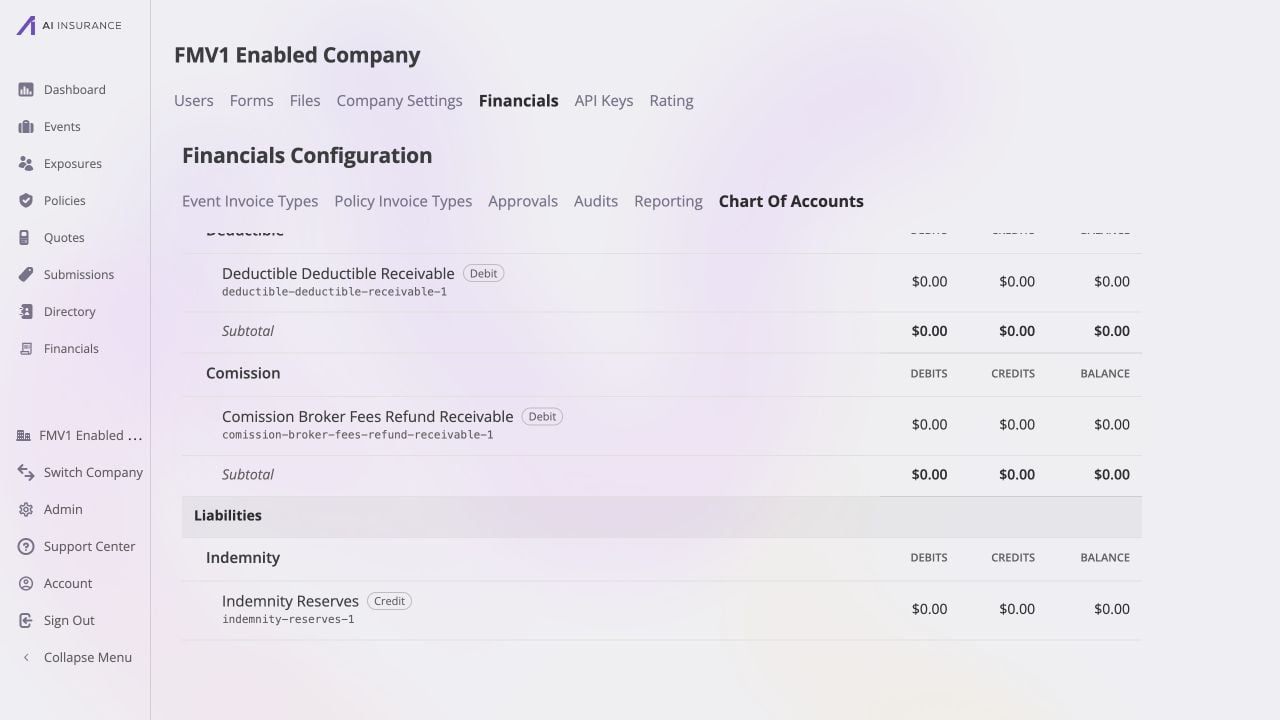
The product exposes the same relationship on the [Event Invoice Types
page](/financials/pages/event-invoice-types) and the read-only [Chart of
Accounts page](/financials/pages/chart-of-accounts). The local fixture below
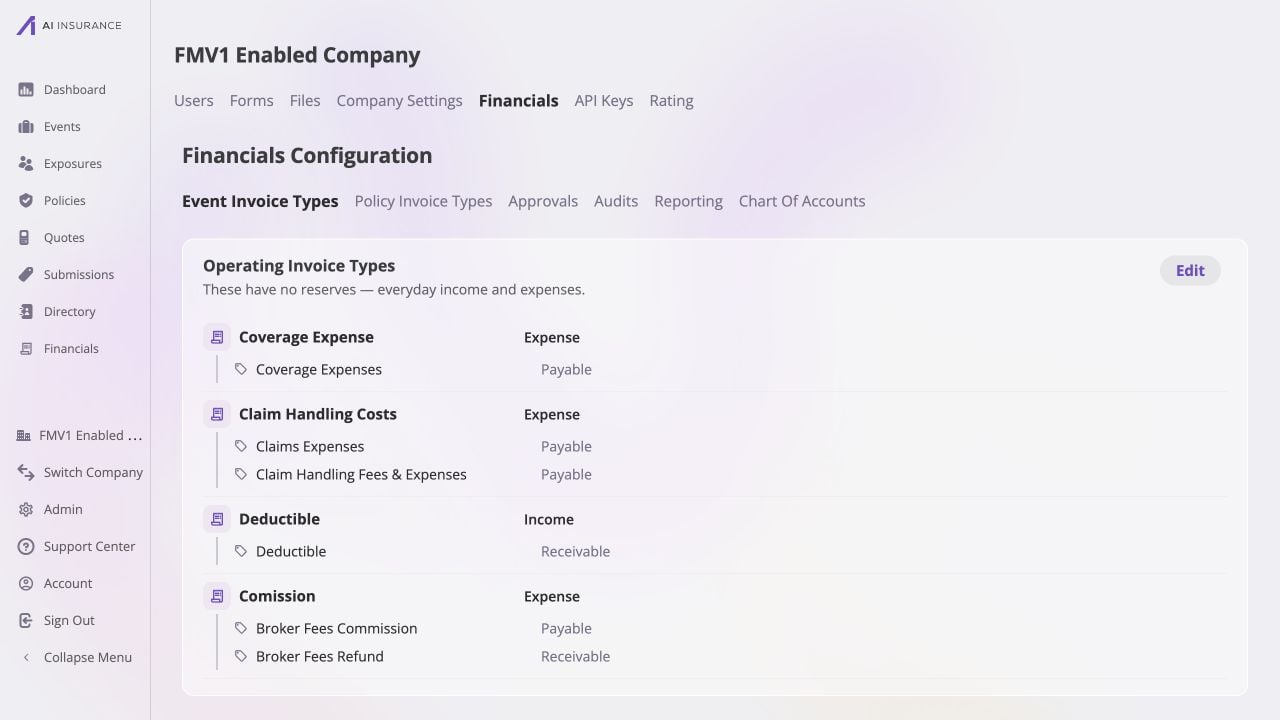
uses `Comission` as its Invoice Type name and gives the two line items their
full display names.

<AccordionGroup>
  <Accordion title="Invoice type configuration">
    <Frame caption="The Operating Invoice Type named Comission contains Broker Fees Commission as a Payable line item and Broker Fees Refund as a Receivable line item.">
      <img src="https://mintcdn.com/ai-insurance-fmv1/KUACnGLYPk7ilVVt/assets/app/financials/concepts/accounting-model-event-invoice-type.jpg?fit=max&auto=format&n=KUACnGLYPk7ilVVt&q=85&s=f622ce096d69bd5e4f3881c26e265ce0" alt="Event Invoice Types page showing the Comission Operating Invoice Type with Broker Fees Commission marked Payable and Broker Fees Refund marked Receivable" width="1280" height="720" data-path="assets/app/financials/concepts/accounting-model-event-invoice-type.jpg" />
    </Frame>
  </Accordion>

  <Accordion title="Fees (outbound)">
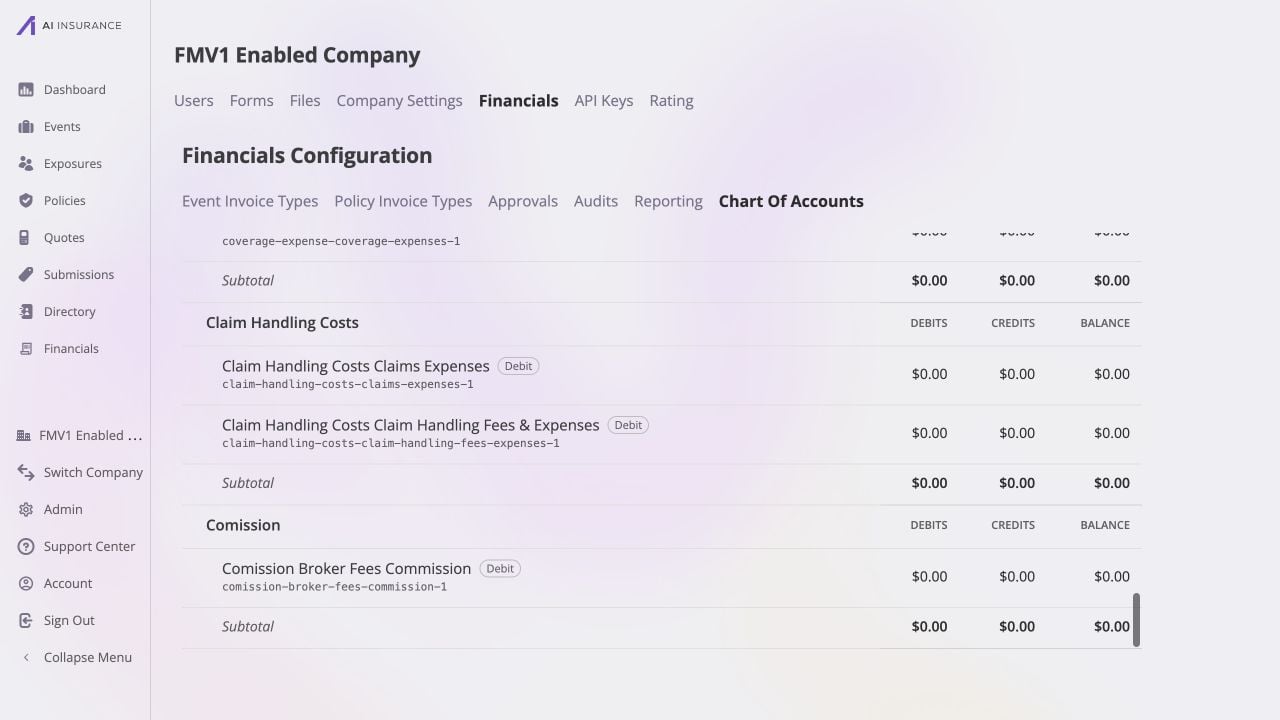
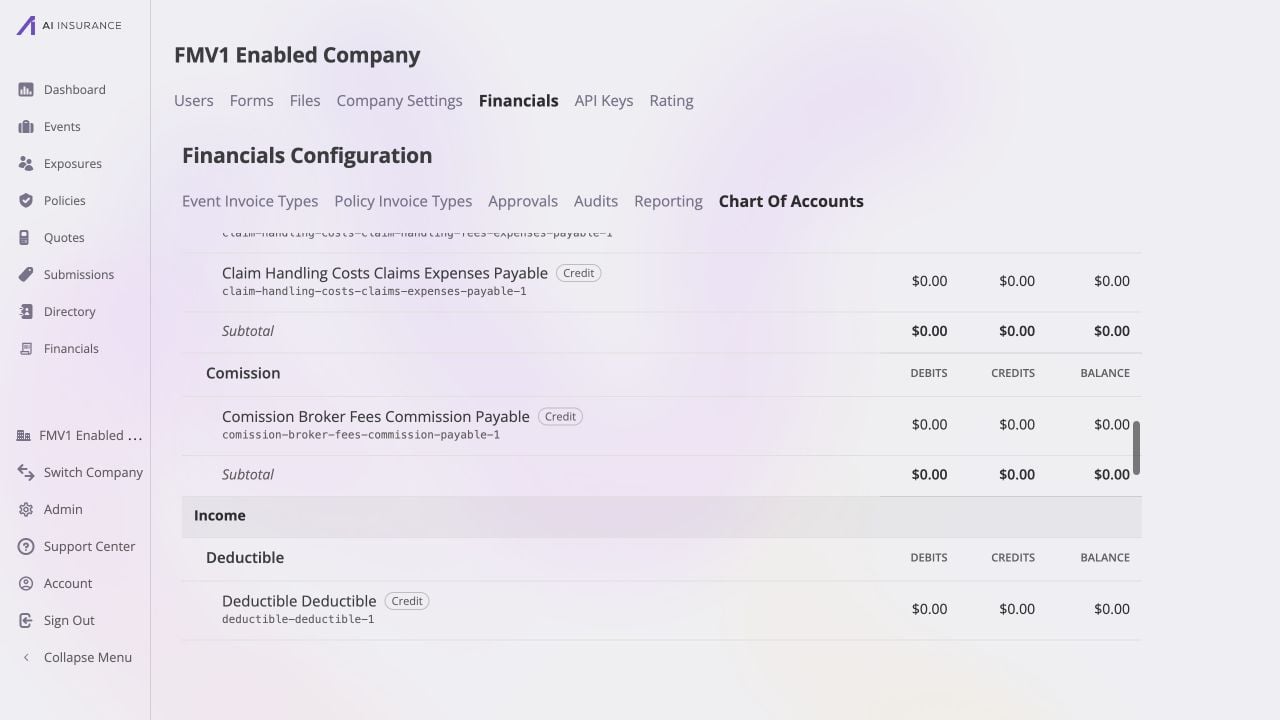
    The outbound `Broker Fees Commission` line item creates an expense account
    and its matching payable.

    <Frame caption="The expense half appears as Comission Broker Fees Commission under Expenses. It is debit-normal and uses the stable key comission-broker-fees-commission-1.">
      <img src="https://mintcdn.com/ai-insurance-fmv1/KUACnGLYPk7ilVVt/assets/app/financials/concepts/accounting-model-fees-expense.jpg?fit=max&auto=format&n=KUACnGLYPk7ilVVt&q=85&s=5f155bbcd9524933a84f4def11af99f1" alt="Chart of Accounts Expenses section showing the debit-normal Comission Broker Fees Commission account and its stable key" width="1280" height="720" data-path="assets/app/financials/concepts/accounting-model-fees-expense.jpg" />
    </Frame>

    <Frame caption="The liability half appears as Comission Broker Fees Commission Payable under Liabilities. It is credit-normal and uses the stable key comission-broker-fees-commission-payable-1.">
      <img src="https://mintcdn.com/ai-insurance-fmv1/KUACnGLYPk7ilVVt/assets/app/financials/concepts/accounting-model-fees-payable.jpg?fit=max&auto=format&n=KUACnGLYPk7ilVVt&q=85&s=0b4b7f4900677162298c8cab8f738a47" alt="Chart of Accounts Liabilities section showing the credit-normal Comission Broker Fees Commission Payable account and its stable key" width="1280" height="720" data-path="assets/app/financials/concepts/accounting-model-fees-payable.jpg" />
    </Frame>
  </Accordion>

  <Accordion title="Fees refund (inbound)">
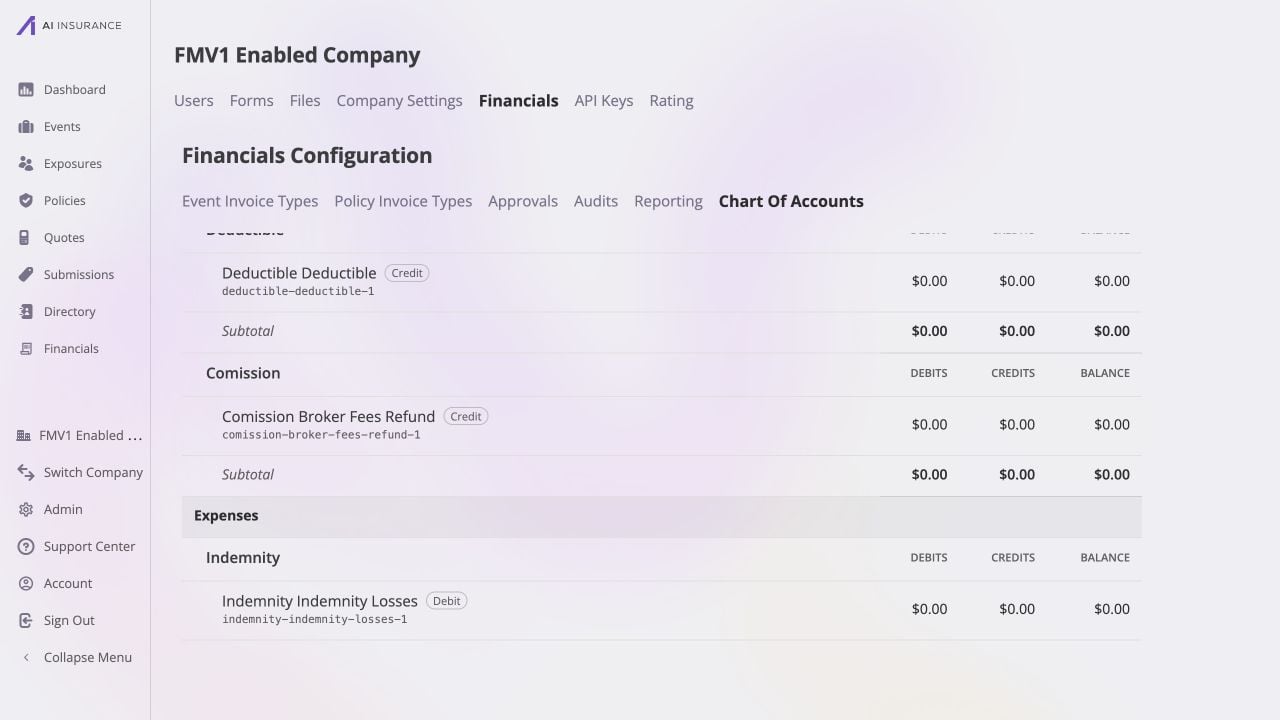
    The inbound `Broker Fees Refund` line item creates an income account and its
    matching receivable.

    <Frame caption="The income half appears as Comission Broker Fees Refund under Income. It is credit-normal and uses the stable key comission-broker-fees-refund-1.">
      <img src="https://mintcdn.com/ai-insurance-fmv1/KUACnGLYPk7ilVVt/assets/app/financials/concepts/accounting-model-refund-income.jpg?fit=max&auto=format&n=KUACnGLYPk7ilVVt&q=85&s=61e220997b3c3655b0ab85563918d419" alt="Chart of Accounts Income section showing the credit-normal Comission Broker Fees Refund account and its stable key" width="1280" height="720" data-path="assets/app/financials/concepts/accounting-model-refund-income.jpg" />
    </Frame>

    <Frame caption="The asset half appears as Comission Broker Fees Refund Receivable under Assets. It is debit-normal and uses the stable key comission-broker-fees-refund-receivable-1.">
      <img src="https://mintcdn.com/ai-insurance-fmv1/KUACnGLYPk7ilVVt/assets/app/financials/concepts/accounting-model-refund-receivable.jpg?fit=max&auto=format&n=KUACnGLYPk7ilVVt&q=85&s=664e25780f0ab65263d53842684839fc" alt="Chart of Accounts Assets section showing the debit-normal Comission Broker Fees Refund Receivable account and its stable key" width="1280" height="720" data-path="assets/app/financials/concepts/accounting-model-refund-receivable.jpg" />
    </Frame>
  </Accordion>
</AccordionGroup>

#### Video walkthrough

Watch the complete example, from configuring the two line items through
inspecting all four generated accounts.

<div style={{ position: "relative", paddingBottom: "64.98194945848375%", height: 0 }}>
  <iframe
    src="https://www.loom.com/embed/8466c0c180544ea39a80468bba62d0b3"
    title="Configuring the Broker Fees example and inspecting its generated accounts"
    frameBorder="0"
    allow="fullscreen; picture-in-picture"
    allowFullScreen
    style={{
  position: "absolute",
  top: 0,
  left: 0,
  width: "100%",
  height: "100%",
}}
  />
</div>

<Info>
  The **keys** for the three core accounts are direction-agnostic — `-reserves`,
  `-unpaid`, `-additional` — even though their display names are not. A machine
  reading `alae-unpaid-1` and `subrogation-unpaid-1` resolves both the same way; only
  the words a human sees change with direction.
</Info>

## Accounts Are Frozen at Birth

An account's name is fixed the moment it is minted, and there is no operation
anywhere that renames, re-parents, or re-orients one. The [Chart of Accounts
page](/financials/pages/chart-of-accounts) is therefore an inspection surface,
not an account editor.

<Warning>
  **Renaming an Invoice Type does not rename its accounts.** The type's display name
  changes everywhere in the product; the accounts it minted keep the name they were
  born with. This is deliberate — a ledger row posted last year must still be
  readable against the account name it was posted to.
</Warning>

Each account also has a stable machine key — `indemnity-unpaid-1`,
`alae-legal-fees-payable-1` — which is what exports and integrations resolve
against. The trailing number makes the key unique: deprecating an "Indemnity" type
and creating a new one mints `indemnity-unpaid-2` alongside the original, so the
old postings stay attached to the old account.

The only account that can ever be removed is one that has **never been posted
to** — deleting a configuration row you just created by mistake. Once a single
ledger row exists against an account, it exists permanently.

## The Four Sections Are a Lens, Not a Structure

Accounts read into the four familiar sections:

<CardGroup cols={4}>
  <Card title="Assets" icon="building-columns" />

  <Card title="Liabilities" icon="file-invoice-dollar" />

  <Card title="Income" icon="arrow-down-to-line" />

  <Card title="Expenses" icon="arrow-up-from-line" />
</CardGroup>

But no account *stores* which section it is in, and no account is a heading. The
section is worked out at the moment of reading, from the account's role plus the
direction behind it:

| Role           | Expects money out | Expects money in |
| -------------- | ----------------- | ---------------- |
| **Cash**       | Assets            | Assets           |
| **Line item**  | Expenses          | Income           |
| **Payable**    | Liabilities       | —                |
| **Receivable** | —                 | Assets           |
| **Reserves**   | Liabilities       | Assets           |
| **Unpaid**     | Liabilities       | Assets           |
| **Additional** | Expenses          | Income           |

Deriving this rather than storing it has one consequence worth stating plainly:
**every account can be posted to.** There are no structural rows — no roots, no
rollups, no headings that exist to organize but cannot carry a balance. The
grouping you see when reading the chart is computed over accounts that all hold
real money.

## Balances by Entity

Alongside the ledger, Financials keeps a running balance per **account per
entity** — for events, policies, and payees. This is what makes "the outstanding
balance on this claim" or "what we owe this vendor" answerable without scanning
the ledger.

Like everything in the read tier, these are derived and rebuildable. The ledger
remains the authority; the per-entity balances are a summary of it kept current as
actions land. Those summaries feed the [Company Event
Financials](/financials/pages/event-financials-page) and [Event Financials
tab](/financials/pages/event-financials-tab) views.

## Appendix: Every Minting Rule

The complete set. Nothing else mints an account, and there are no other
combinations.

### Company level

| Trigger                                              | Mints | Key      | Role | Section |
| ---------------------------------------------------- | ----- | -------- | ---- | ------- |
| The first configuration change of the company's life | Cash  | `cash-1` | Cash | Assets  |

Exactly one, for the company's whole life. It has no Invoice Type behind it, and
every payment in the system posts against it.

### Invoice Type level

Read from the **Invoice Type's** expected direction. `<T>` is the type's name at
the moment of minting, `<t>` its slug.

| Kind              | Expects       | Mints                      | Key                | Role       | Section     |
| ----------------- | ------------- | -------------------------- | ------------------ | ---------- | ----------- |
| **Operating**     | either        | *nothing*                  | —                  | —          | —           |
| **Loss/Recovery** | money **out** | `<T> Reserves`             | `<t>-reserves-N`   | Reserves   | Liabilities |
|                   |               | `<T> Unpaid Losses`        | `<t>-unpaid-N`     | Unpaid     | Liabilities |
|                   |               | `<T> Additional Incurred`  | `<t>-additional-N` | Additional | Expenses    |
| **Loss/Recovery** | money **in**  | `<T> Reserves`             | `<t>-reserves-N`   | Reserves   | Assets      |
|                   |               | `<T> Unpaid Recoveries`    | `<t>-unpaid-N`     | Unpaid     | Assets      |
|                   |               | `<T> Additional Recovered` | `<t>-additional-N` | Additional | Income      |

An Operating type mints nothing at this level because it has no reserves — there
is nothing to hold, so no account is created to hold it.

### Line Item Type level

Read from the **line item's own** direction, independently of its type's. Applies
to line items on **both** kinds of Invoice Type, identically.

| Line item expects | Mints                | Key                    | Role       | Section     |
| ----------------- | -------------------- | ---------------------- | ---------- | ----------- |
| money **out**     | `<T> <L>`            | `<t>-<l>-N`            | Line item  | Expenses    |
|                   | `<T> <L> Payable`    | `<t>-<l>-payable-N`    | Payable    | Liabilities |
| money **in**      | `<T> <L>`            | `<t>-<l>-N`            | Line item  | Income      |
|                   | `<T> <L> Receivable` | `<t>-<l>-receivable-N` | Receivable | Assets      |

### Counting

For one Invoice Type with *n* line items:

| Kind          | Accounts minted |
| ------------- | --------------- |
| Operating     | 2*n*            |
| Loss/Recovery | 3 + 2*n*        |

Plus the one company-wide Cash account, shared by every type.

<Note>
  `N` is the uniqueness suffix, and it is almost always `1`. It increments only when
  a stem is already taken — deprecating an "ALAE" type and creating a new one by the
  same name mints `alae-unpaid-2` beside the original `alae-unpaid-1`, so postings
  made against the old configuration stay attached to the old accounts.
</Note>
