
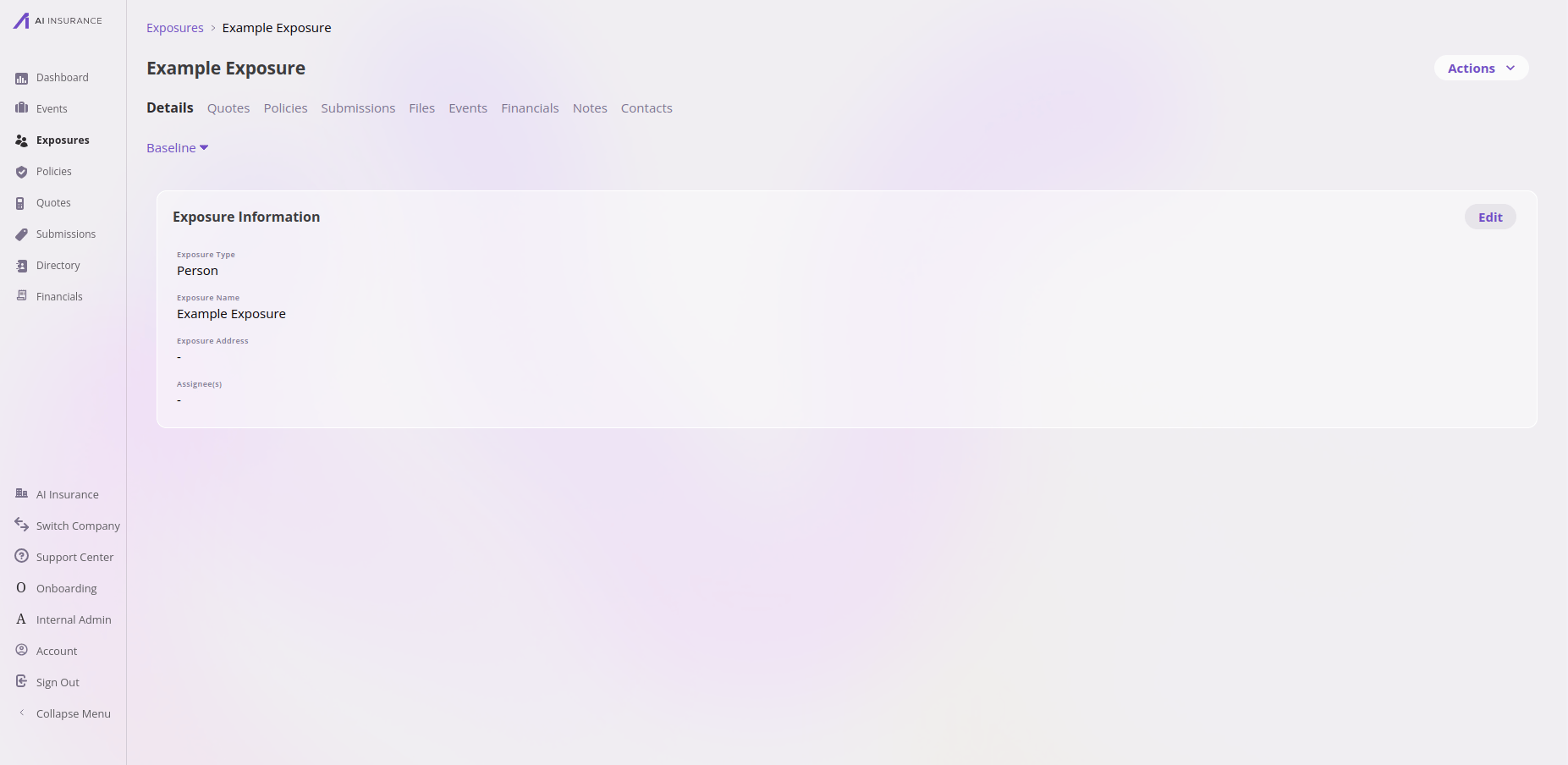
An exposure in the app — its details, with tabs for the quotes, policies, submissions, and events that reference it. The Baseline selector switches between the canonical record and a policy's view of it.
Working in the app? See the Exposures feature reference for the list view, creating exposures, and the cross-reference detail hub.
How its data works
An exposure is a set of fields configured per company. The platform requires a name and a type; beyond that, the details you capture about a risk are entirely up to your configuration. The exposure record is the single source of truth for that risk’s own data.What it connects to
Exposures are the hub — every other part of the workflow can reference them (all many-to-many):
Each of those entities holds its list of exposures; the exposure reads back the
reverse — “which quotes/policies/submissions/events reference me?” — automatically.
How exposures attach to policies
This is the part of the model that’s easy to get wrong, so it’s worth spelling out. An exposure relates to a policy differently from how it relates to a submission or quote. A submission or quote simply points at an exposure — a shared link. But a policy needs to be able to change the facts about an exposure over the life of the term (an endorsement updates an address, a building value, a vehicle) without rewriting history or affecting anyone else’s view of that exposure. So a policy keeps its own private copy of the exposure’s data, embedded in the policy itself, with a permanent pointer back to the canonical exposure record:- The canonical exposure keeps existing on its own, with its own page, no matter how many policies cover it.
- Each policy that covers it gets its own copy of the exposure’s data, which it can edit independently. The copy starts identical to the original and may drift from it over time.
- The copy and the original never sync — only the pointer between them is shared.
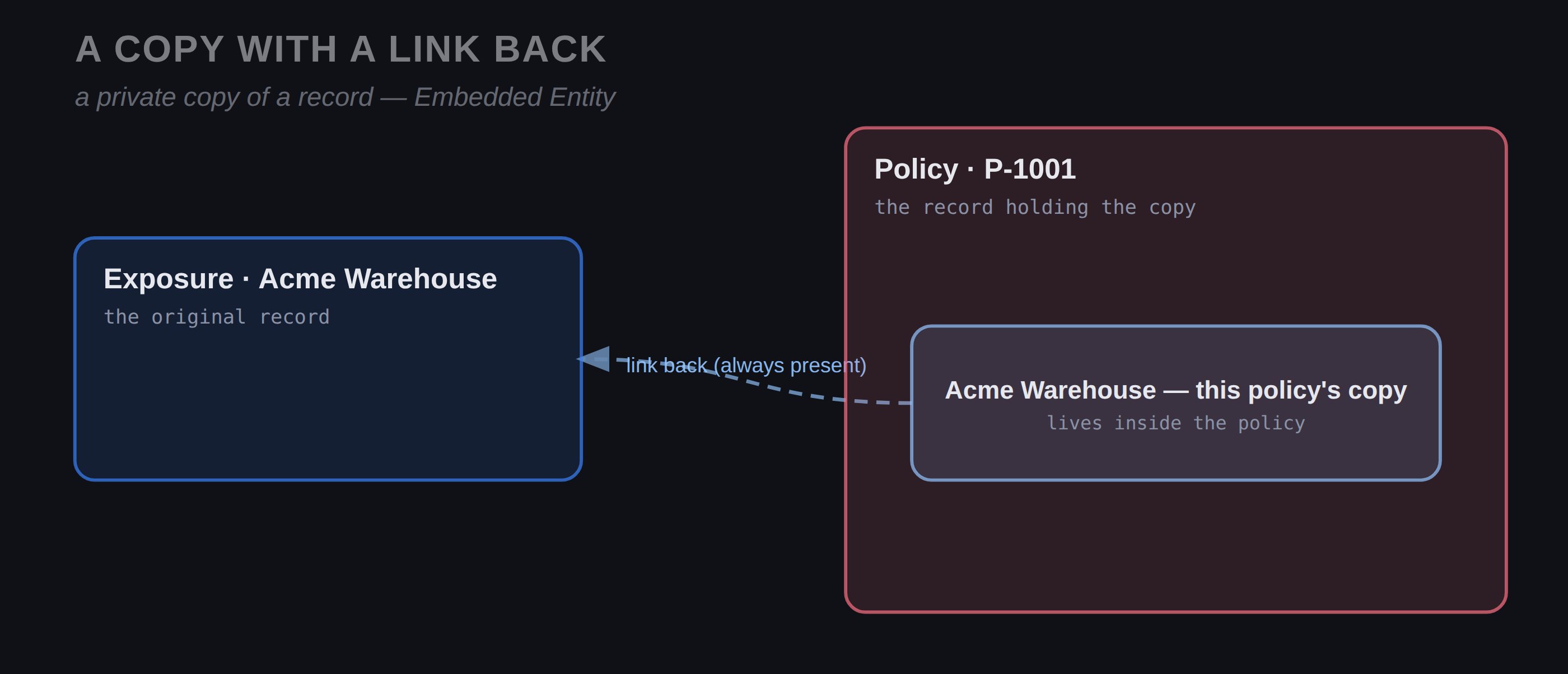
A policy keeps its own private copy of an exposure's data, with a permanent link back to the canonical Exposure record. The copy and the original never sync.
Files, Notes & Contacts
Exposures support all three shared tabs: upload files, record notes, and attach contacts (people from the directory).Technical reference
Technical reference
API. Managed through the unified entity CRUD surface as
exposure. See the
Entities API overview.Framework-required fields.The “own copy on a policy” described above is an embedded exposure field on the
Policy side — a copy of the exposure’s data with a required pointer back to the
canonical exposure id. Additional fields are configured per company; discover them
via the
/entities/exposure/configuration endpoint.