
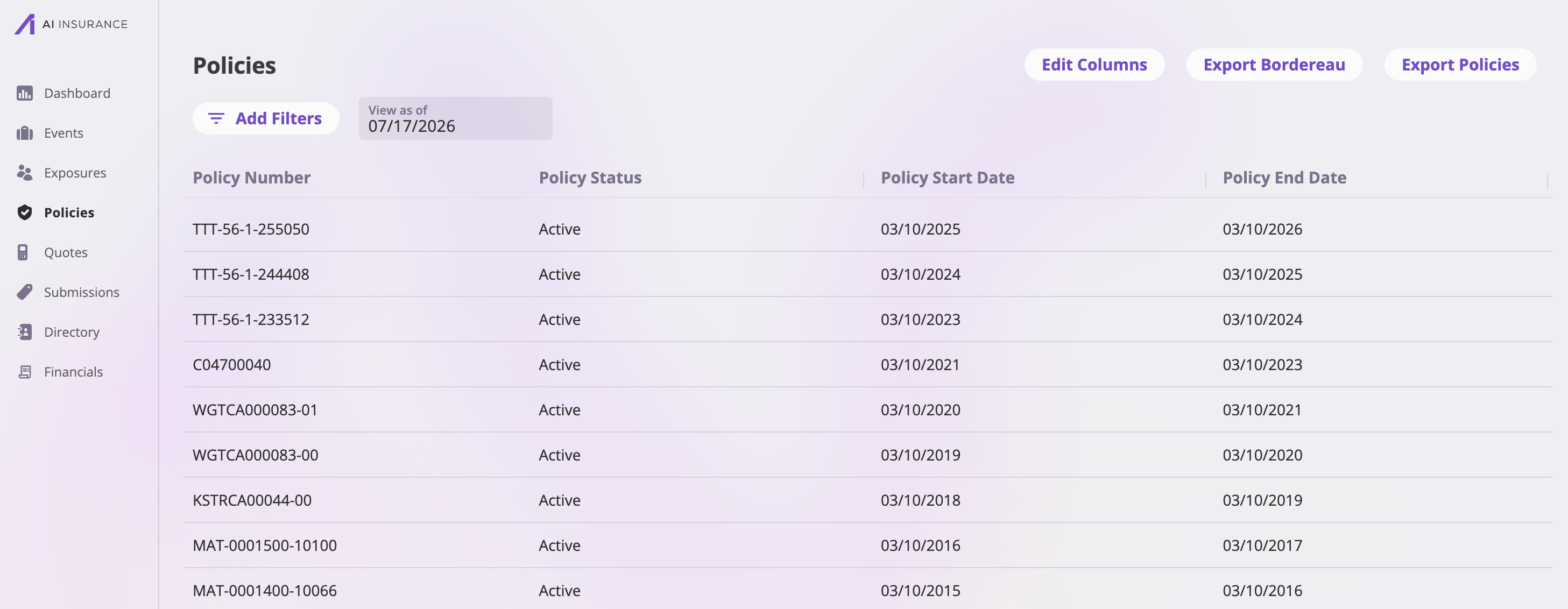
The app: sidebar navigation on the left, breadcrumbs across the top, and the working area — here, the Policies list.
AI Insurance is configured per company: the fields on your records, the
pages that display them, the dropdown choices, and the rules that drive them
are all set up for your specific program. Your app may show different fields
and tabs than the screenshots in these docs. See
How your app is configured.
The lifecycle at a glance
The heart of the app is the path a risk takes from first contact to an in-force, serviced policy:1
Submission
A request to be quoted arrives — entered by hand, imported from files, or
created from an email. The submission is where you record the applicant and
check for clearance issues before doing any work. See
Creating submissions.
2
Quote
From a submission you work up one or more quotes in the quote wizard —
a step-by-step flow through quote details, exposures, rating information,
coverages, billing, and forms, ending with review and send. See
Quoting new business.
3
Bind
When the insured accepts, you bind the quote. Binding runs a short flow of
its own — policy details, policy forms, review and bind — and produces a
policy: the bound, in-force contract. See
Binding a quote.
4
Service the policy
Over the policy’s life you endorse it (change it mid-term), renew it into a
new term, cancel it, or reinstate a cancelled policy. Each of these runs as
its own guided flow, and the policy keeps a full history you can browse.
See Servicing a policy.
5
Claims
When something happens, you record an event — a claim or an incident —
against the policy, manage it in the claim workspace (files, notes,
contacts, legal, financials), and set reserves and record losses. See
Handling claims.
6
Billing
Premium flows into invoices, and invoices get paid — including by the
insured directly through a shareable payment link. See
Billing & getting paid and the
Financials section.
Where things live
The sidebar mirrors the lifecycle. Each area has a feature-reference page with the full detail:Dashboard & tasks
Your task calendar and list — follow-ups, reminders, and assignments.
Submissions
Incoming requests to be quoted, and file/email imports.
Quotes
Priced offers, their statuses, and quote actions.
Policies
Bound contracts, activity history, renewal chains, and exports.
Events
Claims and incidents, and the claim workspace.
Exposures
The insured things, cross-referenced from everywhere.
Directory & contacts
People and organizations, linked to records as contacts.
Financials
Invoices, payments, reserves, and financial reports.
Next steps
- Signing in & your account — get into the app and manage your sign-in methods.
- Navigating the app — the sidebar, the record workspace pattern, and how list pages work.
- How your app is configured — why your screens may differ from these docs.
- Entities overview — the data model behind it all.