
- The Files tab appears on submissions, exposures, and events, and there’s a company-wide Company Files area for files that don’t belong to any one record — on the Files page in the sidebar, under the Company Files tab. Its other tab, All Files, lists every file across every record in one table.
- The Notes tab appears on submissions, quotes, exposures, events, and directory records (people and organizations).
What you can do follows your permissions. The tabs only show for roles
that can read files or notes, and each action below (upload, rename, delete,
download, …) appears only if your role is allowed to perform it — a button
you can’t use either doesn’t render or shows a tooltip explaining why.
The Files tab
The Files tab is a small file manager for the record: a folder tree on the left, and the current folder’s contents on the right with a breadcrumb above them. Folders list first, then files, in a table with Name, Category, Type, and Upload date columns — click a header to sort. A checkbox on each file row lets you select several files at once for bulk actions.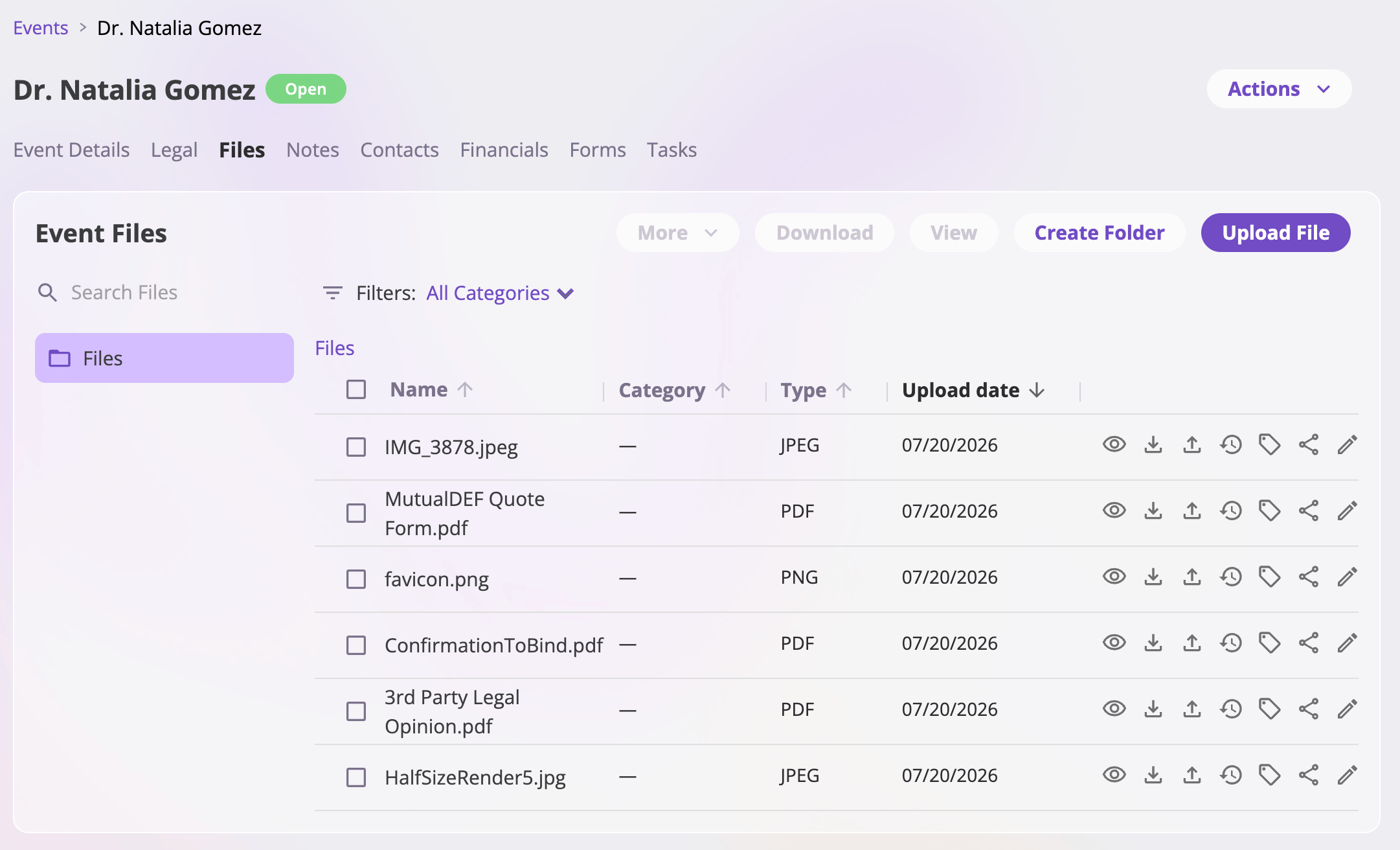
The Files tab — folder tree, breadcrumb, search and category filter, and per-file actions.
Uploading files
Select Upload File and pick one or more files — or simply drag files anywhere onto the tab (“Drop files to upload”). Uploads land in the folder you’re currently viewing. While files upload, each shows a progress row with its size and status, and a cancel button if you change your mind. Two limits are enforced as you upload:- Size — up to 1 GB per file.
- Type — common business formats are accepted: PDF, Word, Excel,
PowerPoint, images (PNG, JPEG, GIF, WebP, TIFF, HEIF), CSV, plain text,
JSON, ZIP, email messages (
.msg,.eml), audio and video, and a few others. A file of an unsupported type is rejected with a message naming it.
Folders
- Create Folder adds a folder inside the current one — type a name and select Create. Folders can be nested as deep as you like.
- Rename a folder with the pencil icon on its row — edit the name in place.
- Move folders and files by drag and drop: drop a row onto a folder row, a breadcrumb segment, or a folder in the sidebar. (A folder can’t be moved into its own subfolder.)
- Delete a folder with the trash icon on its row. This is recursive — the confirmation warns that the folder, its subfolders, and all files inside are permanently deleted.
File actions
Each file row carries a strip of icon actions (hover for the tooltip). Actions your role can’t perform don’t appear.
Selecting one or more files with the row checkboxes enables the toolbar
actions:
- Download — downloads the selection (multiple files arrive as a ZIP).
- View — opens a preview when exactly one file is selected.
- More ▾ — bulk operations on the selection: Move… (pick a destination folder from a tree), Set Category…, and Delete… (with a confirmation that spells out what’s permanent).
Categories
Categories are labels for organizing files, drawn from your company’s configured category lists — set one with Set category on a row (or Set Category… for a whole selection). The picker offers the categories configured for this record’s entity type (a Policy file is offered the Policy list, a claim file the Event list), in the order your admins arranged them, plus No category to clear. Company admins manage the lists — adding, renaming, reordering, and retiring categories — on the File Categories card in Company Settings. The category filter above the table narrows the list to one category. It also includes labels that are no longer on the configured list but still appear on files, so older data stays findable. A file carrying such a retired label keeps it until you pick a different category — re-saving it unchanged keeps working, but the old label can’t be applied to anything new.Previews
Preview (or View in the toolbar) opens PDFs in a full in-app viewer. Other file types open in a new browser tab, where the browser shows what it can (images, text) and downloads the rest. Files still being scanned, or flagged as infected, can’t be previewed or downloaded — the disabled button’s tooltip explains why.File versions
Uploading a new version of a file (the Upload new version action) keeps the file’s identity — its name, category, and every place it’s attached — and adds the new content on top. Version history shows every version, newest first: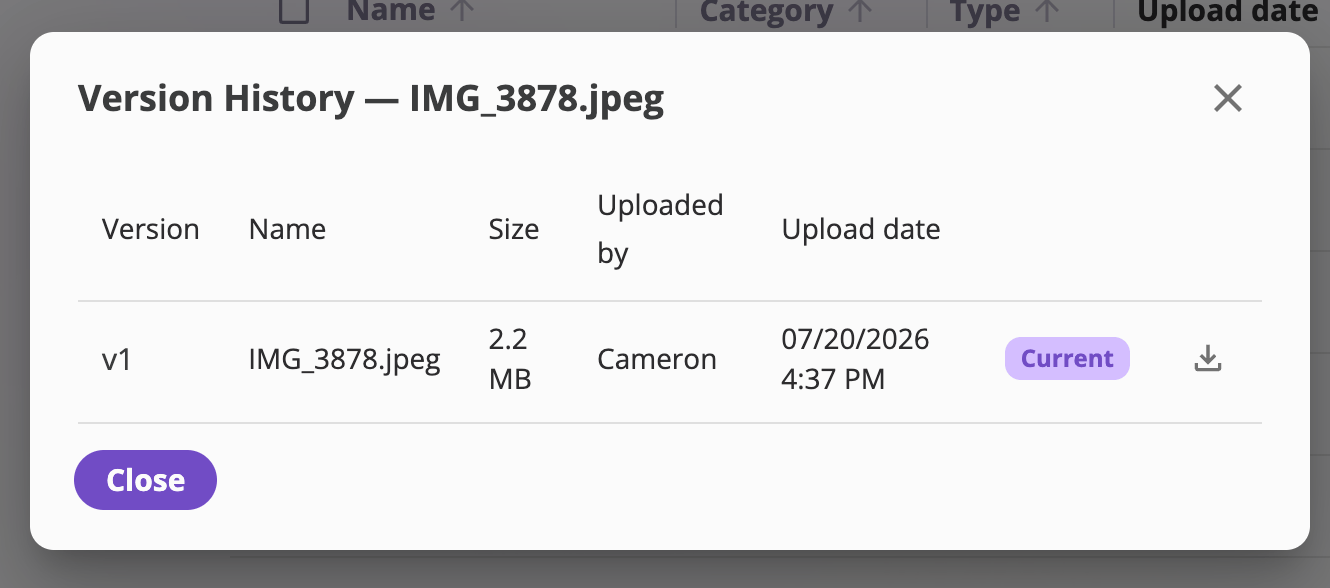
Version history — every version with its size, uploader, and date, plus download and restore.
- Each version lists its number (v1, v2, …), name, size, uploader, and upload date; the live one carries a Current badge.
- Download any past version.
- Restore an older version to make it current again — nothing is deleted, the chosen version simply becomes current (“v2 becomes the current version; nothing is deleted.”).
One file, many records
A file can be attached to more than one record at a time — it’s shared, not copied, so every appearance shows the same content (and the same version history).- Add to another entity on a file row opens a dialog: pick the entity type (or Company Files), search for the target record, and the file appears there too — “File added. It now appears on both entities.”
- A shared file shows a shared icon next to its name (“Shared — appears in N places. Click to see where.”). Click it for the “Also appears on:” list, with a link to every other record carrying the file.
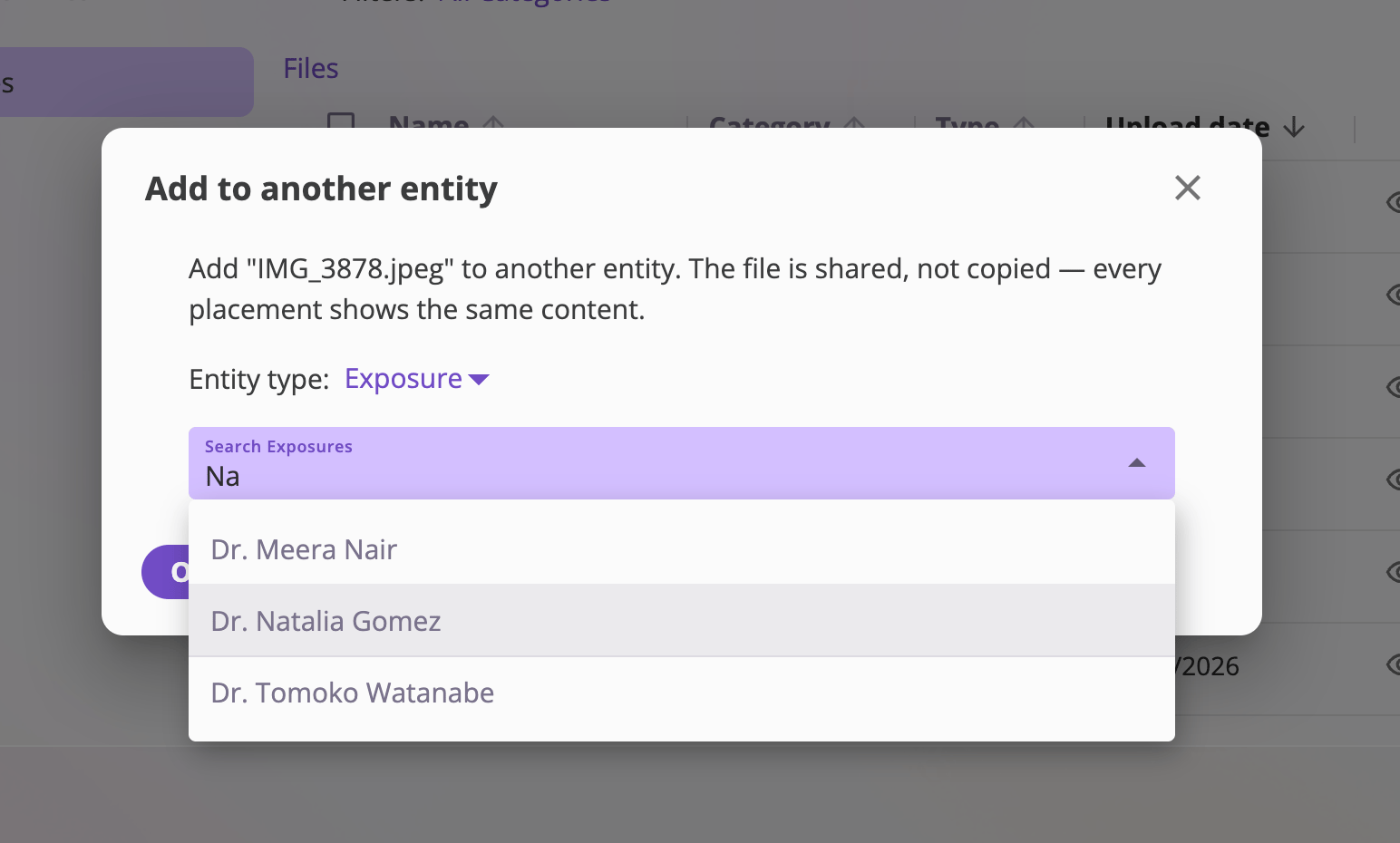
A shared file's placements — every other record it appears on, as links.
Malware scanning
Files uploaded to AI Insurance are scanned for malware before they’re released for use:- While a file is being checked, its row shows Scanning… — it can’t be previewed or downloaded yet (“Scanning for malware — available once the scan completes”).
- If malware is detected, the file is permanently blocked: its row shows a red Infected badge, and preview and download are disabled for good (“Malware detected — this file cannot be downloaded”). The same applies per version — an infected version of an otherwise healthy file can never be downloaded or restored.
- Infected files can still be deleted like any other file.
The Notes tab
The Notes tab is a running log of free-form commentary on the record.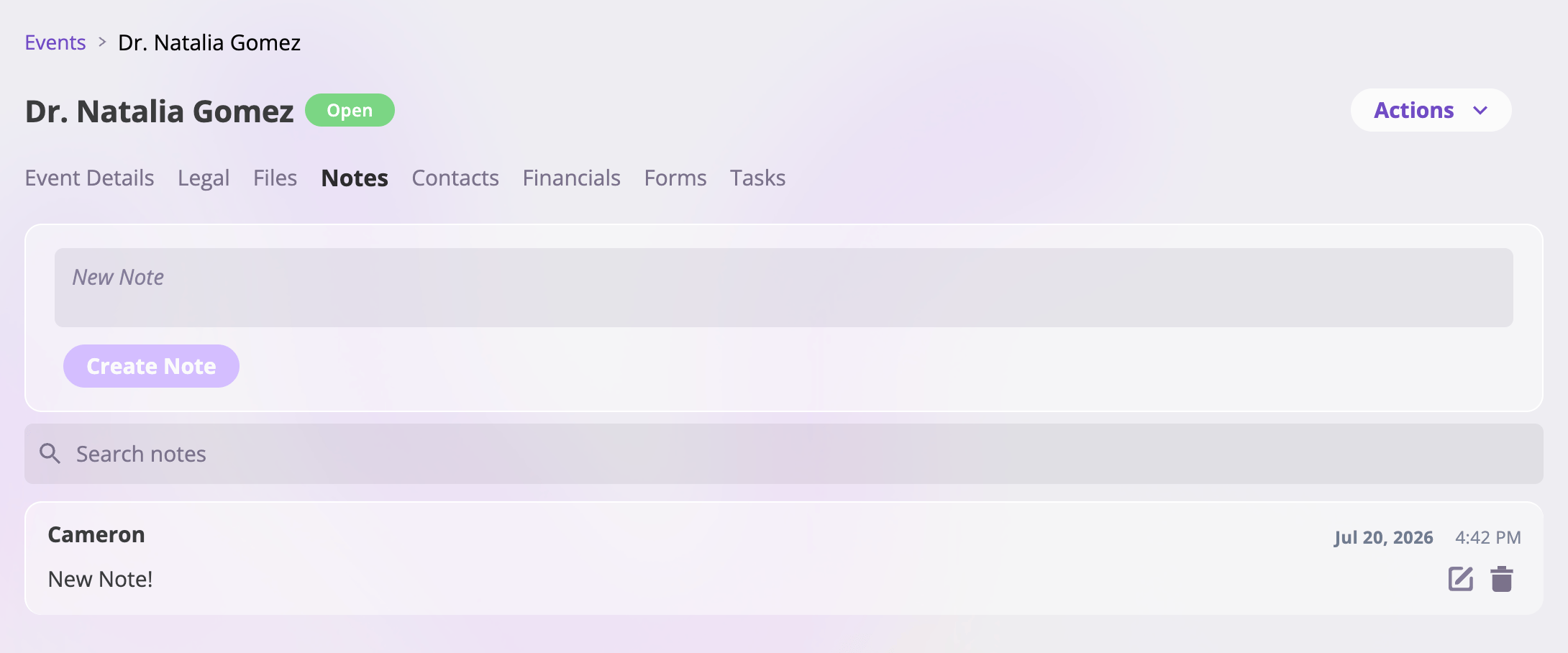
The Notes tab — a New Note box on top, then every note with its author and date.
- Create — type into the New Note box at the top and select Create Note. Notes are plain text; line breaks are preserved.
- Search — the Search notes box filters the list as you type.
- Edit — the pencil icon on a note opens it for editing in place; Save or Cancel.
- Delete — the trash icon asks for confirmation (“Are you sure you want to delete this note? This action cannot be undone.”) and permanently removes the note.
- Privileged — if your role can view privileged notes, the New Note box offers Visible to everyone or Privileged, privileged notes carry a Privileged tag, and a lock icon marks or un-marks a note (un-marking asks you to confirm, since it reveals the note to everyone who can view notes). Users without that permission never see privileged notes, and generated documents never include them.