
The policy Actions menu
The Actions menu at the top right of the policy’s detail page collects the servicing actions: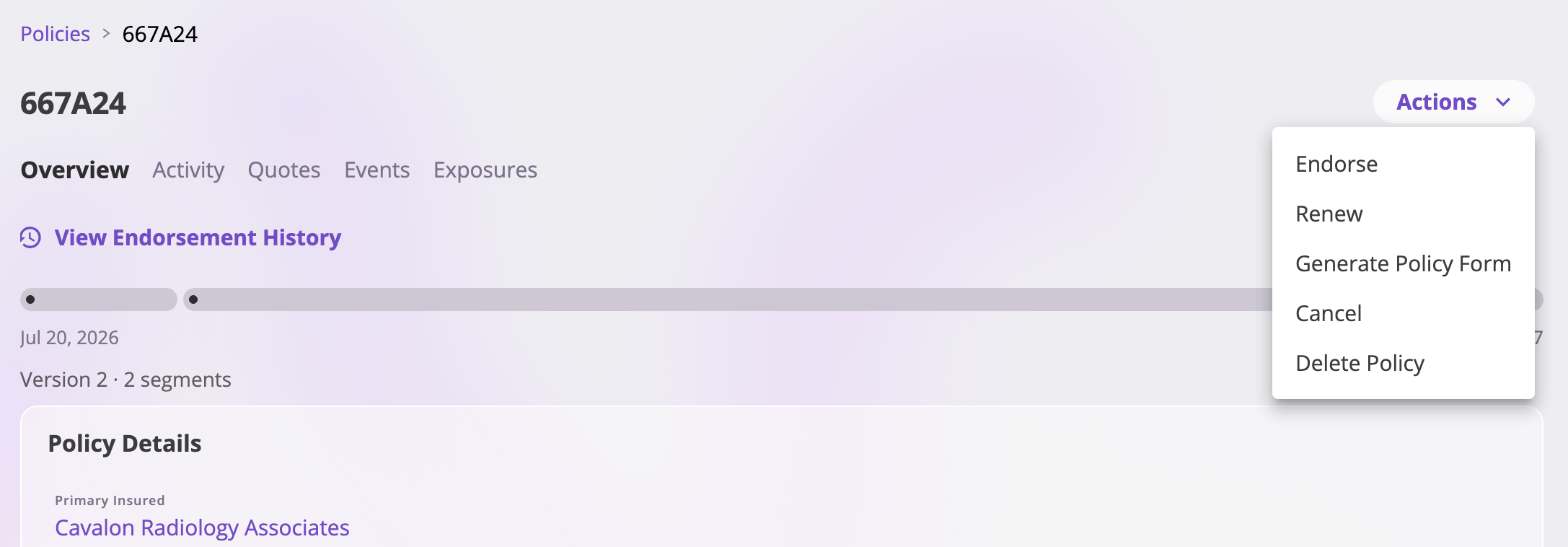
The Actions menu on an active policy.
How the servicing flows work
Endorse, renew, cancel, and reinstate all follow the same shape:- You start from the policy — a dialog collects the date(s) the change needs (renew needs none).
- A wizard opens where the change is worked as its own quote — a full quote for endorsements and renewals, a short three-step flow for cancellations and reinstatements. Like any quote, it can be saved and resumed, and it moves through the same statuses: an endorsement or renewal goes In Progress → Quote Complete → Bound to Policy; a cancellation or reinstatement goes straight from In Progress to Bound to Policy when confirmed.
- The change lands on the policy at the final bind or confirm — for an endorsement, select Bind Endorsement on the wizard’s last step (or complete the quote first and bind it from its page later); for a renewal, complete the quote, then select Bind Quote on its page; either way you finish the bind flow with its final bind button. For a cancellation or reinstatement, select Confirm Cancellation / Confirm Reinstatement on the wizard’s last step. Nothing changes on the policy until that final action — an in-flight servicing quote can always be discarded.
Endorse (a mid-term change)
Use Endorse for any change during the policy term: adding or removing an exposure, changing a limit, correcting a value, updating the insured’s details.Choose the dates
Actions → Endorse opens the Endorse policy dialog:- Effective date — the day the change starts applying. It must fall within the policy term (the dialog tells you the term if you pick outside it).
- Through end of policy — checked by default: the change applies from the effective date to the end of the term. Uncheck it to set an explicit End date instead, for a change that only applies for part of the term — say, an extra insured for the summer months. The end date must be on or after the effective date and within the term.
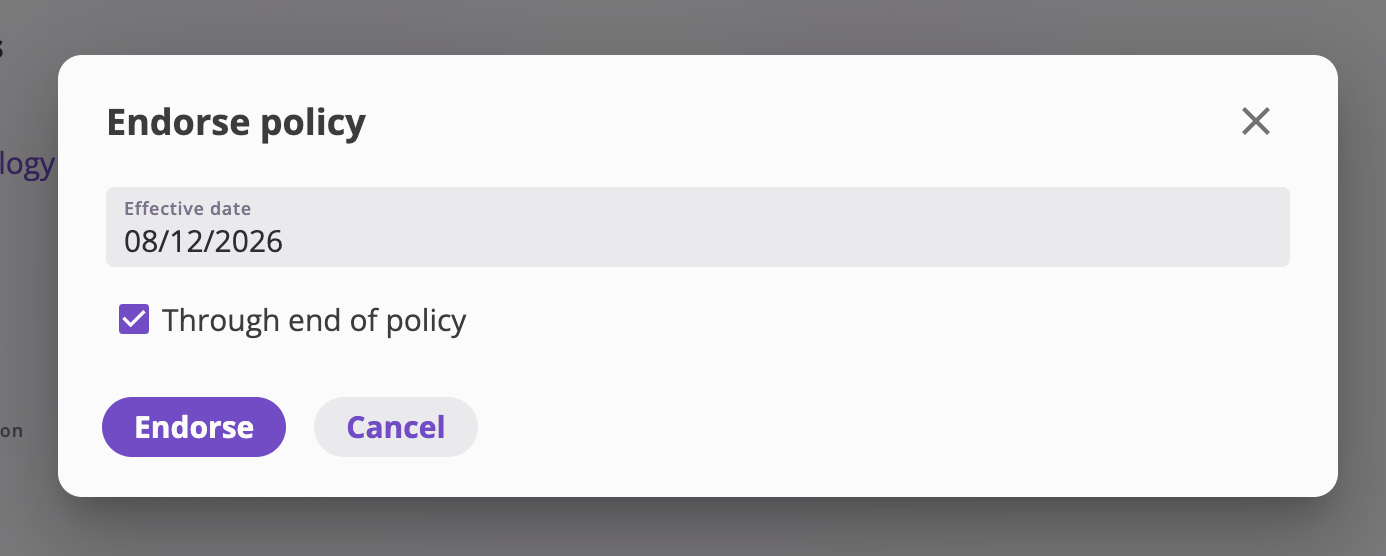
The Endorse policy dialog — an effective date, and either 'through end of policy' or an explicit end date.
Effective dates in plain terms: the effective date is when the change
applies on the policy, not when you’re entering it. Pick a past date to
record a backdated correction — the policy then reads as if the change
had been in force since that date. Pick a future date to book a change
ahead of time. Either way the Activity log separately
records when it was filed, so the audit trail always shows both dates.
Work the endorsement
Confirming the dialog opens the endorsement in the quote wizard, pre-filled from the policy as it stands on your effective date. What gets pre-filled is decided by your company’s Policy → Quote conversion rules, so a value the rules leave out arrives blank. It’s the same wizard as quoting — the first step is titled Endorsement Details, followed by Exposures, Rating Information, Coverages, Billing, Forms, and Review — so you change what’s changing, re-rate to price it, and generate any endorsement documents, with the rest carried over by the rules. While an endorsement is unbound, the policy’s page shows a persistent banner — “You have an endorsement in progress.” — with two actions:- Continue — opens the endorsement quote to keep working it.
- Discard Edits — after a confirmation, permanently deletes the in-progress endorsement (its quote and the submission created with it). This can’t be undone.
Bind the endorsement
The wizard’s last step, Review and Confirm, ends with two buttons:- Bind Endorsement (the primary action) — saves the endorsement and goes straight into the same short bind flow as new business (Policy Details, Endorsement Forms, then Review and Confirm), finished with Bind Endorsement. Most endorsements take this path: the change is ready, so it’s bound in one pass.
- Complete Endorsement Quote — marks the endorsement Quote Complete and returns you to its detail page without touching the policy. Use it when the change needs to sit as a quote first. When it’s ready to apply, select Bind Endorsement on the completed endorsement’s page (the standout button at the top right, also an Actions menu entry) to enter the same bind flow.
There’s no rush between completing and binding. Like a new-business quote,
an endorsement can be saved mid-wizard and resumed later (Continue
Editing on its page while it’s In Progress), completed, and bound
whenever the change is ready — the policy is untouched until Bind
Endorsement. If the endorsement shouldn’t happen after all, use the
policy banner’s Discard Edits to delete it.
What binding it does
Selecting Bind Endorsement at the end of the bind flow applies the change to the policy:- The app works out exactly which fields changed and records them as a new version of the same policy, effective over the date window you chose. Outside that window the policy is untouched — an endorsement effective April 1 changes nothing about January–March.
- The endorsement quote’s status becomes Bound to Policy, the banner clears, and the endorsement appears in the policy’s endorsement history and on its Activity tab.
- The policy keeps one continuous record: viewing it as of a date before the effective date shows the old values; on or after, the new ones.
Renew
Actions → Renew starts the next policy term. There’s no date dialog — the renewal opens straight into the full quote wizard, seeded from the expiring policy’s latest state, with the new term dates defaulted so the new term starts where the expiring one ends (all editable in the flow). From there it’s a normal quote: adjust exposures and coverages, re-rate, generate forms. To issue the new term, finish the wizard the same way as an endorsement: select Complete Quote on the final Review and Confirm step, then Bind Quote on the completed renewal quote’s page, and work the short bind flow — Policy Details (the new term’s policy number), Policy Forms, and Review and Confirm — ending with Bind Policy. (Like any quote, a renewal can also be saved mid-wizard and picked up later — nothing is issued until Bind Policy.) Bind Policy creates a new policy — its own policy number, term, and history — linked to the term it renews; the renewal quote’s status becomes Bound to Policy and you land on the new policy’s detail page. The new term may start on or after the expiring term’s end date, but the two terms can’t overlap. The link shows on both policies’ Overview tabs:- Renewed From — on the new policy, linking back to the expiring one.
- Renewed Into — on the old policy, linking forward (with a More link if several renewal terms trace back to it).
Cancel
Actions → Cancel ends coverage mid-term. It’s offered while the policy is currently active and has no cancellation recorded.1
Pick the cancellation date
The Cancel policy dialog asks for a single Cancellation date — the
day coverage ends. It must fall within the policy term. Selecting
Continue opens the cancellation flow (nothing is cancelled yet).
2
Review the money
The cancellation flow’s Billing step shows the financial effect. Each
charge on the policy is recalculated for you server-side to what that
charge had earned by the cancellation date — the insured owes only for the
coverage they had, and a charge your company models as non-refundable
(fully earned at inception) stays whole. Existing charges are not yours to
edit here; what you can do is add one — a short-rate penalty, a
cancellation fee — which is charged in full on the cancellation date. If a
charge itself is wrong, endorse the policy first and then cancel.
3
Cancellation Forms
Generate the cancellation notices from your company’s policy form
templates — the same forms tooling as everywhere else.
4
Review and Confirm
A final read-through, finished with Confirm Cancellation.
- The policy’s status is Cancelled from the cancellation date through the end of the term. For dates before the cancellation date it still reads as active — the coverage that existed isn’t erased.
- A future cancellation date leaves the policy active today with a pending cancellation booked; it takes effect automatically when the date arrives. (While one is pending you can’t stack a second cancellation — reinstate first to change the date.)
- The cancellation appears on the Activity tab like any other transaction.
Reinstate
Actions → Reinstate undoes a cancellation — offered whenever the latest state of the policy carries one, whether it has already taken effect or is still pending. The Reinstate policy dialog explains what will happen and shows the Reinstatement date, pre-filled with the policy’s cancellation date and locked to it. That’s deliberate: reinstatement applies as of the cancellation date, voiding the cancellation so coverage runs uninterrupted through the end of the term, and the whole pre-cancellation pricing is restored — every charge, not just the premium: taxes, fees and commissions all come back at the amounts the policy carried before it was cancelled.A reinstatement can’t leave a gap in coverage — you can’t cancel June 15 and
reinstate “from July 1”, leaving two uncovered weeks. If coverage genuinely
lapsed and should restart later, that’s a new term: quote it as new business
or a renewal instead.
The policy’s history
The Overview timeline
The policy’s Overview tab opens with a timeline bar spanning the term. The bar is split into a pill per period during which the policy’s values were constant, dots mark the effective date of every change (inception included), and the purple fill shows how much of the term has elapsed. Below it, a caption reports the current version and period count, and the fields shown on the page are the policy as of the date in view — today, by default.
The Overview timeline — one pill per period of constant values, a dot per change, purple fill up to today.
Endorsement history
Select View Endorsement History (or click any dot or pill on the timeline) to browse how the policy evolved:- A full-width Viewing Endorsement History banner takes over the page — the policy is read-only while browsing (the Actions menu is hidden) — with Exit to return to the live, current-date view.
- A side rail lists Endorsements by Effective Date, newest first, the original policy at the bottom. Expanding an entry shows exactly which fields that change touched; clicking a date shows the policy as of that date, with the fields that endorsement changed highlighted on the page.
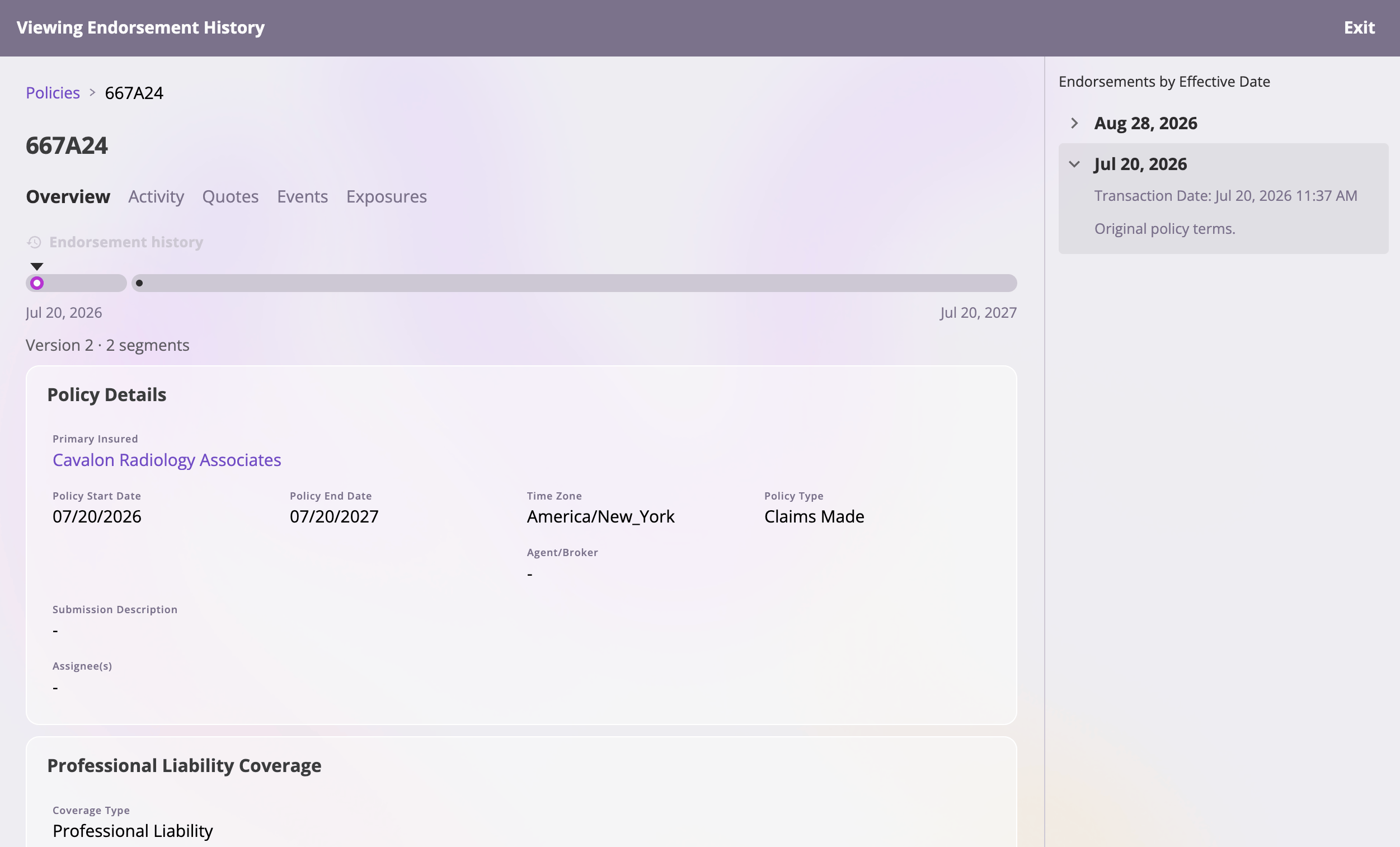
Endorsement history — the rail lists each change by effective date; the page shows the policy as of the selected date with the changed fields highlighted.
The Activity tab
The Activity tab is the policy’s transaction log — every transaction, newest first. Each row shows:- Effective — where on the term the change applies.
- The transaction type and version it produced (new business, endorsement, cancellation, …).
- Filed — when it was recorded, and by whom.
- View policy as of this date — jumps to the Overview showing the policy as of the transaction’s effective date.
- Undo this transaction — on the most recent transaction only. After a confirmation, it reverts the policy to its previous version. Older transactions can’t be undone from the middle of the history — and an undo is blocked (with the reason shown) when other records, like invoices, already depend on that transaction.
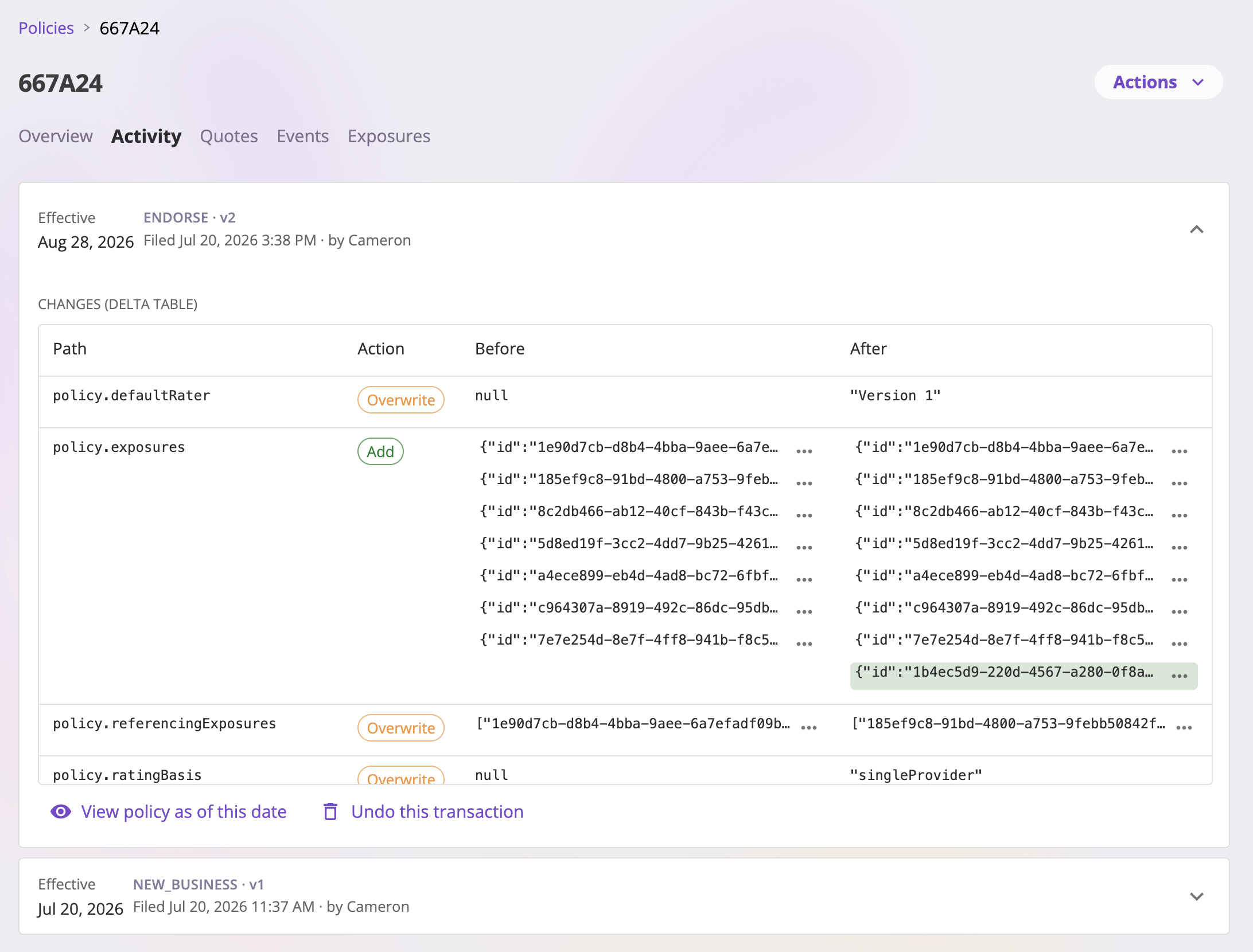
The Activity tab — every transaction with its effective and filed dates; the latest one can be undone.
Effective vs. Filed are two different clocks. Effective is where the
change lands on the policy term; Filed is when it entered the system. A
correction filed in June can be effective March 15 — the policy reads
correctly from March, and the log still shows the decision was made in June.
(API users: the same model is documented in Effective Dates & the Policy
Timeline.)
Viewing the book as of a date
Because policies are date-resolved, you can view them as of any date — not just today.The Policies list
The Policies list has a View as of date field in its toolbar. It defaults to today; pick another date and every row re-resolves to what that policy looked like on that date — statuses, limits, exposures, premium — which is how you answer “what did our book look like on June 30?”. While viewing a non-today date, a Today link resets the lens. Your chosen date sticks for the browser tab as you navigate away and back, and it carries into list exports, so an exported book matches what’s on screen.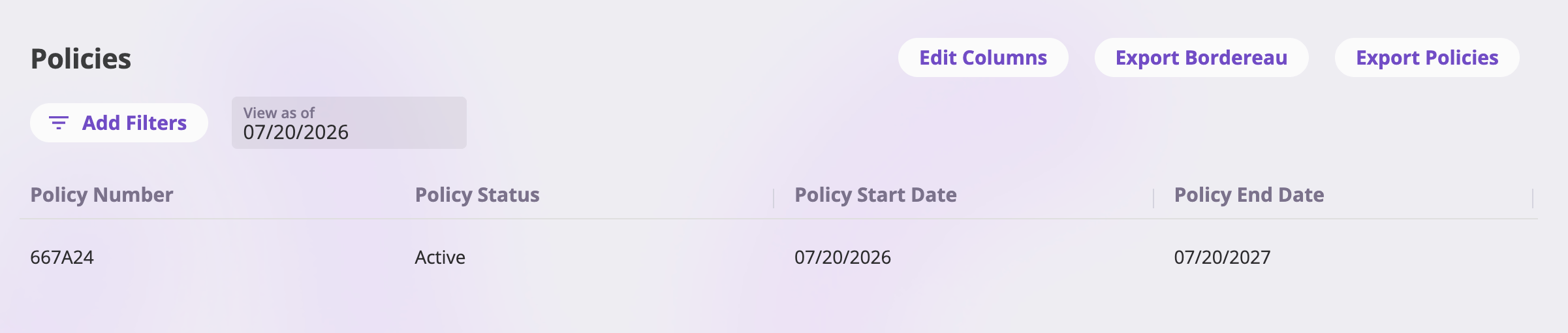
The Policies list viewed as of a past date — every row resolves to that date, with a Today link to reset.
A single policy
On a policy’s detail page, the date in view is driven by the timeline, the endorsement history rail, or an Activity row’s View policy as of this date — and it survives switching between the policy’s tabs, so Overview and Activity stay on the same date while you investigate.Generate a policy form as of a date
Actions → Generate Policy Form opens the policy’s Generate Policy Forms surface. Its as-of date starts at today — the right answer for most notices and letters — and must stay within the policy term; pick another date to document the policy as it stood then. Each document fills its values from the policy exactly as it stood on that date, so a certificate generated “as of March 1” reflects March’s coverage even if the policy has been endorsed since. That makes the same template at two dates two different documents, and the surface lets you compose both. Issue records the composed forms in one immutable Issued packet on the policy’s Forms tab, beside the packets of every bind. The packet — not the working documents behind it — is frozen; a later edit or smart-tag refresh never changes it. Download it whole, or expand it and download one document. Full walkthrough: Generating forms.Policy status, in dates
A policy’s status is date-scoped — the same policy can be active for June and cancelled for July:
The status shown on the Policies list is the status as of the list’s “View
as of” date. A policy whose term has simply ended isn’t marked with a
special status — its term dates tell you it has expired, and
renewal is how the account continues.