
The Statuses
Status Is Derived, Not Set
The app reads the status like this, first match winning:- Created as a draft and not yet finalized → Draft
- Voided → Void
- Every line item’s amount is zero → No Charges
- Every line item is fully settled → Paid
- No payments recorded at all → Owed
- Otherwise → Partially Paid
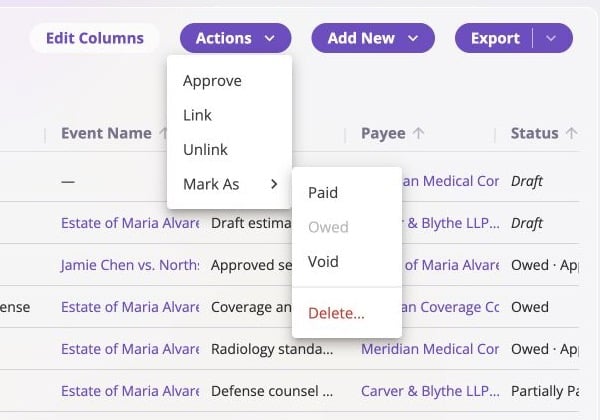
Bulk lifecycle actions perform the financial transition behind the status; they do not simply overwrite a label.
Drafts
Draft is the one status that says nothing about money. A draft is an invoice that exists as a document but has not been finalized: nothing is recorded against it, and it contributes to no total, no report figure, and no reserve. A draft is never typed by hand. Two things produce one:- Document parsing. An invoice read out of a PDF lands as a draft, for review before it counts.
- The external API. A create call can bring an invoice into being unfinalized.
Creating an Invoice
1
Choose the type
The type decides which line items are available. It cannot be changed later.
2
Break the amount into line items
Add one or more line items and enter each amount on its Income or Expense
side. At least one line item is required, and each needs a type.
3
Set the invoice date
Required. This is when the money is recognized, and it is the date reports
count the figure from. On an invoice linked to a policy it may be in the
future — that is how a scheduled installment is recorded. On an invoice
linked to an event, or on an unlinked one, it cannot.
4
Fill in the rest
Due date, payee, memo, and any files. Optional.
5
Create it as Owed or Paid
Owed records the obligation and nothing else. Paid also records a settling
payment for the full amount, and needs a paid date.
Dates
Three dates, doing three different jobs:Recording Payments
Payments are recorded per line item. A payment is an amount against one line item, with its own date and an optional memo — the same unit the payment history lists and the app later edits. The Record Payment menu on an invoice offers the two ways to do it:
Settling in stages is ordinary: a $15,000 invoice paid in three $5,000
instalments is Partially Paid twice and then Paid.
On a Loss/Recovery type, recording a payment normally updates the event’s
remaining reserve for that type. Sometimes the app asks how the payment should be
applied — see Reserves.
Editing and Removing Payments
The payment history is authored, not append-only. Expanding a line item and opening its history gives every payment on that line — amount and date, both editable — plus Add Payment for another, and a control to remove one. A removed payment shows struck through until the save, and can be restored before then. Revert All Payments, in the invoice’s Actions menu, removes every payment at once and returns the invoice to Owed. A line item never accepts more than its own amount. Payments on a line may sum to less — that is an ordinary partly-paid line — but not to more, and the app reports each line’s outstanding figure as amounts are typed.Worked Example
An invoice with three line items: $1,000 of indemnity and $500 of legal fees on the expense side, and a $300 salvage credit on the income side. Its total is $1,200 expense — the net of the three. A first Record Partial Payment pays the law firm $500 and nothing else:
The invoice is Partially Paid. Two lines are still open — including the
salvage credit, which is money owed to the business and settles only when the
recovery is actually collected.
Mark Paid in Full from here settles both remaining lines on one date, in both
directions at once:
Now every line is settled, so the invoice is Paid. Settlement is judged line by
line, which is why settling the legal fees in full still left the invoice
Partially Paid.
An integration writing through the API has the same two choices: settle the whole
balance due in one call, or name the line items and the exact cents for each. See
Record Payment.
What Can and Cannot Change
Every invoice figure feeds the company’s record of where its money is. That record is only ever added to — a correction is a new entry that supersedes an old one, never a rewrite of what was already written. That single rule decides which changes an invoice allows, and what each one costs.Frozen at Creation
These are the facts the money record was built from. Changing one would not correct that record, it would contradict it. So a correction is not an edit: it is a void and a replacement — void the invoice, create the right one. The freeze never loosens. Reverting a paid invoice to Owed does not unlock its line items, and no later status makes the type or the amounts editable again.Changes That Don’t Touch the Money
The invoice’s dates, its memos, and its files describe the money without moving it. They can be changed on any invoice at any status: a fully paid invoice’s dates and memos edit in place, with its payments left exactly where they are.Changes That Move the Money
Everything else writes to the money record, and divides by whether the app has to walk the invoice through other states to get there. Direct — each writes its own entry. Recording a payment, editing one, removing one. The status simply follows from the result. Composed — the app walks the invoice through the intermediate states. Some changes are legal only on an invoice with no payments against it. Rather than refuse, the app takes the payments off, makes the change, and puts them back, all in one step, after a dialog that spells out the steps — because none of them are visible in the result. Relinking a paid invoice to a different event is the clearest case. Its payments were attributed to the old event, so the invoice cannot simply be pointed elsewhere while they stand:- Remove every recorded payment.
- Move the invoice to the new event.
- Re-record every payment against the new event.
Voiding
Voiding keeps the invoice as a record but takes it out of the numbers entirely. A voided invoice:- still appears in listings, its status reading Void;
- is excluded from every count, total, and report figure;
- opens read-only, offering Restore, and can still be relinked or deleted.
Deleting
Deleting removes the invoice from the app. Unlike voiding, it is not a browsable state — the invoice is gone from listings and reports, and deletion is final. Deleting an invoice has no preconditions: an invoice with payments recorded against it can be deleted, and the app unwinds them.Void and delete answer different questions. Void marks an invoice as not
counting while keeping it visible as a record. Delete removes it entirely.
Void is the right choice when the record itself is meaningful.
Bulk Actions
Company Event Financials and the Event Financials Tab both support multi-select. With rows selected, the Actions menu offers:- Mark As — move the selected invoices to Owed or Paid in bulk, with a confirmation that spells out what will be recorded or removed.
- Approve — see Approvals.
- Link and Unlink — change the primary entity in bulk. Company-wide only; inside an event’s own tab the event is fixed.