
Flow Frame
Signed by which way the money actually flows. Money in is positive, money
out is negative. A $10,000 loss payment is
-10000; a $3,000 recovery is
3000.Type Frame
Signed by whether the money went the way its Invoice Type expects.
Positive in the expected direction. A $10,000 loss on a loss type is
10000; a $3,000 recovery on a recovery type is also 3000. A figure
running against what the type expects is the negative one here.When to Use Each Frame
Flow frame answers “what happened to cash?” A summed column gives the net effect on the business. Losses and recoveries offset each other, which is usually what a finance team wants from a spreadsheet. Type frame answers “how big was this?” A claim’s costs read as positive numbers, which is how most loss runs, bordereaux, and reports to carriers are conventionally presented. A summed column gives total incurred, not a net. Neither is more correct. The right choice depends on who is reading the file.On Screen the Frame Is Carried by Color
Every screen in Financials reads the flow frame, and expresses it with color instead of a sign:- Green — money coming in, where the flow frame would write a positive number.
- Black — money going out, where the flow frame would write a negative one.
$0, uncolored — a real zero. There is no flow to ink.
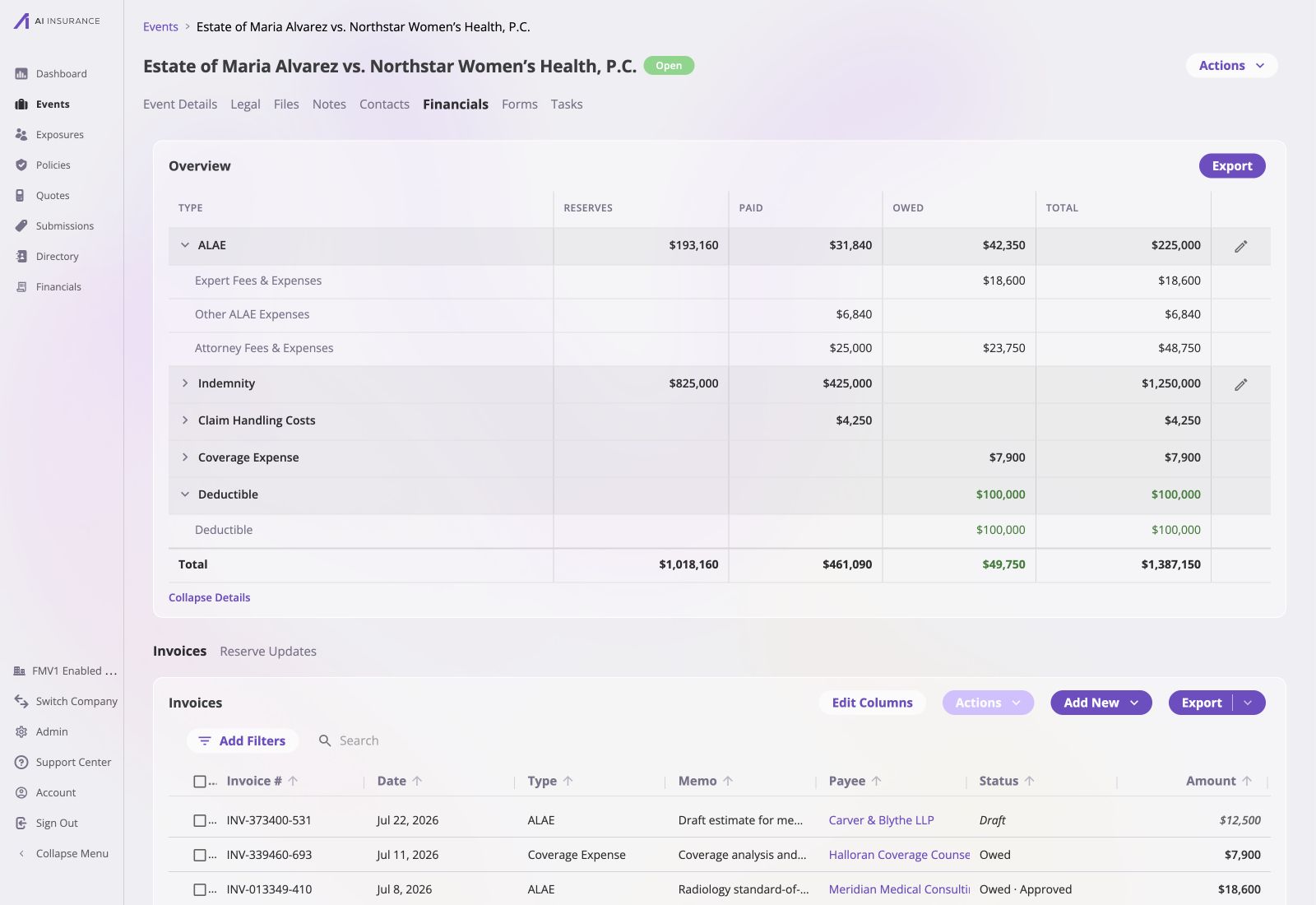
In this event overview, black amounts are money going out through ALAE, Indemnity, Coverage Expense, and claim costs; green amounts are the incoming Deductible and the net owed total after that recovery.
$49,750 owed total is the
net result after that incoming recovery offsets the outstanding outgoing amounts.
The screen never needs a minus sign: color carries the flow frame while the
number stays positive.
So every figure on screen is an unsigned magnitude, and the frame setting changes
nothing about how it looks. Choosing a frame only matters where a figure leaves
the app and a sign has to do the work the color was doing.
A zero is not the same as a missing value. A settled line, a cleared reserve, or
a type with no activity yet shows
$0. A genuinely absent value — no date, no
payee — shows an em dash.Where a Frame Applies
Five surfaces write figures out of the app. Each one carries a frame.
Everything defaults to the flow frame. A company that changes nothing gets
flow-framed signs on every export and every generated document.
Choosing a Frame
Under Admin → Financials Configuration → Reporting, each of the five exports has its own Flow / Type toggle. See Reporting for that configuration surface. The setting is company-wide per export: one choice that every Invoice Type follows, including types created later. The Reporting page names the exact export surface beside each toggle, so a change can be scoped to invoice exports, Overview exports, reserve updates, event exports, or smart tags without changing how figures appear on screen.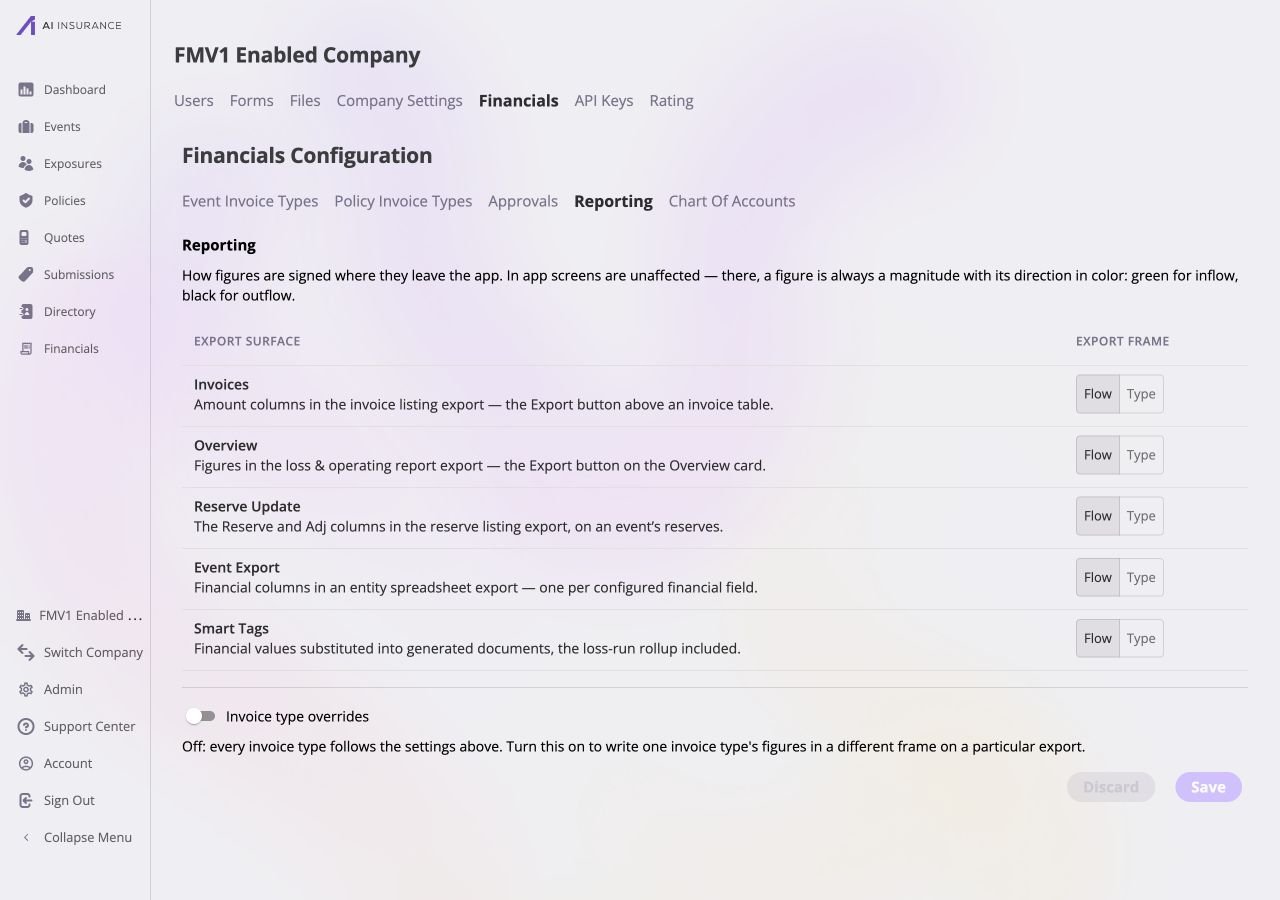
Reporting configuration chooses a Flow or Type frame independently for each export surface.
- Two exports cannot be overridden. Invoices and Overview have amount columns that add up across Invoice Types, so a document mixing frames within one of them would produce a column that sums to nothing meaningful. Both appear in the override picker disabled, with that reason on hover, rather than hidden.
- Flipping a company-wide export to Type warns. In the type frame every figure is positive in its own type’s expected direction, so the sign stops distinguishing money in from money out — which on a column that nets is the sign’s whole job.
- A Reserve Update override on an Operating type has nothing to describe and is dropped: an Operating type holds no reserves.
- Only signs change. Which figures exist, which rows they sit on, and which cells are blank are all unaffected. Zeros stay real zeros.
- Two exports set differently will disagree, on purpose. A smart tag in the
type frame prints
$6,000.00where the flow-framed event export prints-6000. They agree to the cent whenever both are on the same frame — which is the default.
Worked Example
An event with two Invoice Types. Indemnity expects money out: $10,000 expected, $4,000 paid. Subrogation expects money in: $3,000 expected, $1,000 collected.
Subrogation is unaffected. Its money flows in, which is also what its type
expects, so both frames agree. The frames only diverge on types whose expected
direction is money out.
In every frame,
Reserves + Paid = Total holds with signs intact — for
Indemnity, (-6000) + (-4000) = -10000 in the flow frame and
6000 + 4000 = 10000 in the type frame. The three figures are always on the same
side, so a row never sums to zero by accident.