
How a Bill Review Works
A review moves through three visible stages:- Your standards live on Admin → Financials → Bill Review and apply to every invoice in the company.
- A run happens on one invoice, started by you or automatically after an invoice is parsed from an upload.
- The findings come back on that invoice — a banner at the top and a flag beside each field the review has something to say about.
Writing Your Billing Standards
Open Admin → Financials → Bill Review. The Bill review rules section at the top of the tab is where the standards live. Type your restrictions into the Add rules box the way you would explain them to a new employee, not the way they appear in your outside-counsel guidelines. Write everything in one go — the system splits what you type into separate rules for you.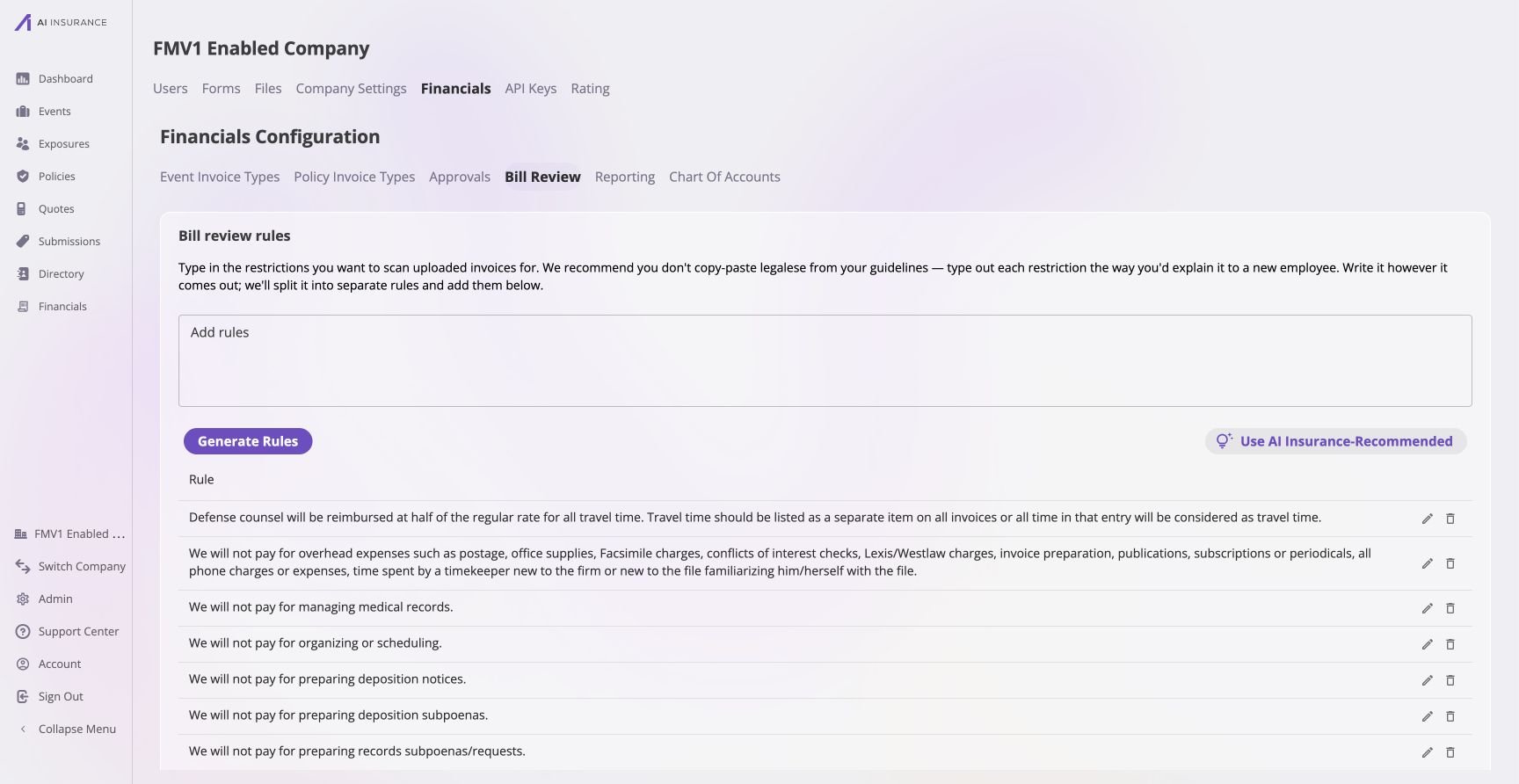
Bill Review keeps the rule generator and the resulting editable rule list together, so you can review every active standard before running it against invoices.
1
Write your restrictions
Type them into the Add rules box. One thought per sentence works best.
For example: no charges for administrative or clerical work; bill time in
tenths of an hour; no block billing; travel time at half rate; no
first-class airfare; no hotel over $350 per night.
2
Add them
Choose Add Rules, or press ⌘/Ctrl + Enter. The box accepts up to 10,000
characters at a time and produces at most 40 rules from one paste.
3
Check the list
Each rule appears as its own row in the Rule table below the box. A
confirmation tells you how many were added — for example
7 rules added.
Expect the count to differ from the number of sentences you wrote: a
sentence covering two restrictions is split into one rule for each, so the
six restrictions above become seven rules.If nothing in your text reads as a restriction you’ll see We couldn’t find
any restrictions in that text. Try writing each restriction as its own
sentence. Rewrite it as separate sentences and add it again. If only some
rules save, the ones that didn’t are put back in the box for you, one per
line.
What a Rule Can Be About
A rule can name any part of the invoice, and the review sees all of it:
Name the field the way the invoice page labels it and the review will find it.
A rule that is about the invoice as a whole rather than any one field —
invoices must be approved before payment — works too.
Running a Bill Review
There are three ways a review starts. All three do the same work; they differ only in how they’re kicked off.One invoice
Open the invoice and choose Actions ▾ → Run Bill Review. There’s no confirmation — the review starts immediately and you’ll see Bill review started.Several invoices at once
In Financials → Event Financials or Policy Financials, select the invoices you want, then choose Actions → Run Bill Review. A confirmation tells you what’s about to happen, including anything it will skip:Run a bill review on 12 transactions. 3 will be skipped (a bill review is already running). Each result appears on its transaction when its run finishes.Review up to 100 invoices in one go.
While a review is running
A spinner appears beside the invoice number and the invoice reads In Progress in a listing. The page keeps itself up to date, so there’s nothing to refresh. This is the one moment a review holds something up: while it runs, Edit and Run Bill Review are both unavailable on that invoice. Hovering Edit explains why — A bill review is running on this transaction. Editing unlocks when it finishes.Reading the Results
Results land in three places.The banner on the invoice
A card at the top of the invoice gives the verdict.- Bill Review Passed — green, with No findings were reported.
- Bill Review Flagged — red, with 4 findings require attention.

A successful bill review appears as a green Passed banner and confirms that no findings were reported.
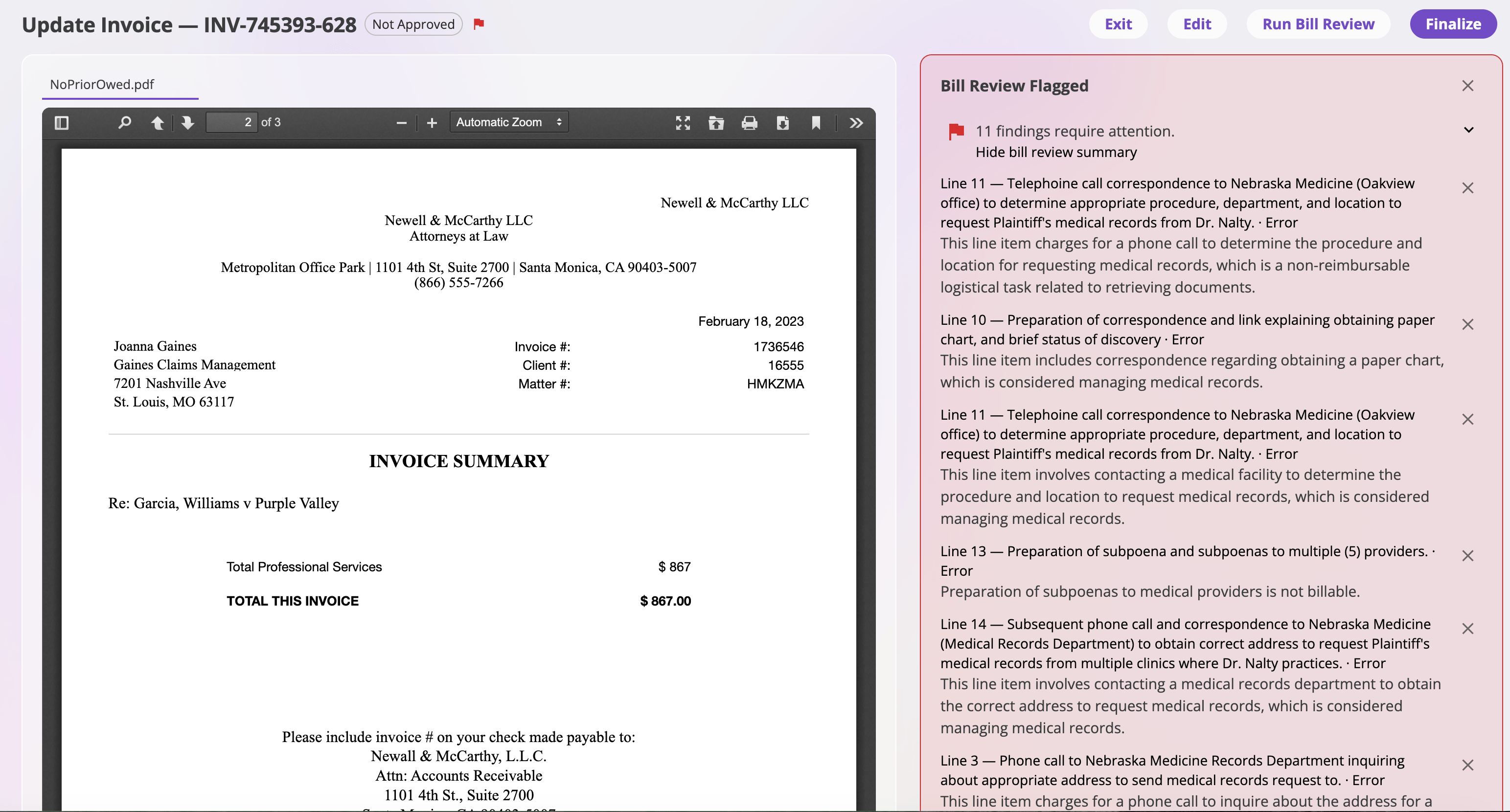
A flagged bill review opens beside the source invoice, grouping each finding by the affected line and explaining which billing rule it violates.
An Info finding does not flag the invoice. A review that reports only info
findings still reads Bill Review Passed, with the findings listed
underneath.
Flags beside the fields
Every finding also puts a small red flag next to the part of the invoice it concerns — the status, the category, the payee, the invoice date, the due date, the memo, the total, the attachments pane, the Payments heading, a specific line item, or a specific payment in the payment history. Choose a flag to read its findings. A number appears on the flag when a field has more than one. The flags look the same whatever the severity; the banner is where severity is shown. A finding about something the invoice page has nowhere to flag is listed at the top of the invoice instead, where it reads and clears the same way. That is where findings about the invoice number, whether the invoice is approved, the amount paid, the balance due, the linked event or policy, one of your own invoice fields, one specific attachment, and the invoice as a whole appear. If you edit the invoice after a review has run, the flags stay but say so: These bill review flags were raised on an earlier version of this transaction. Run the review again to refresh them.The invoice listing
Listings can show a Bill Review column reading In Progress, Passed, Flagged, or Resolved — or— for an invoice that has never
been reviewed. You can filter on those values.
The column is hidden by default on the company-wide listing; add it from Edit
Columns. Whether or not you add it, the same spinner, green check, or red flag
appears beside every invoice number in the list.
Clearing Findings
Findings don’t go away on their own — you clear them once you’ve dealt with them. Nothing is deleted; the run is kept either way.- One finding at a time — the × beside it, in the banner or in a field flag’s popover.
- All of them — Clear all findings at the bottom of the banner.
- Just hide the banner — the × in the banner’s top corner. This tidies the invoice without clearing anything, so the field flags stay and the listing still reads Flagged.
Bill Review History
The lower half of Admin → Financials → Bill Review lists every review the company has run, newest first, including runs whose invoice has since been reviewed again or had its flags cleared.This is the only place a failed review is visible. A run that fails leaves
no banner and no mark on the invoice, and the listing’s Bill Review column
reads
—, exactly as it would for an invoice that was never reviewed. If a
review seems not to have happened, check here — hover the Verdict cell to
read why it failed, then run it again.What You’ll See Under Different Conditions
Verify the result: the invoice shows a green or red banner at the top; a flagged
invoice has a red flag beside each field with a finding; the run appears at the
top of Bill Review History with the trigger you used.
Bill review is separate from approvals — it tells
you what to look at, approval is what lets money move.